
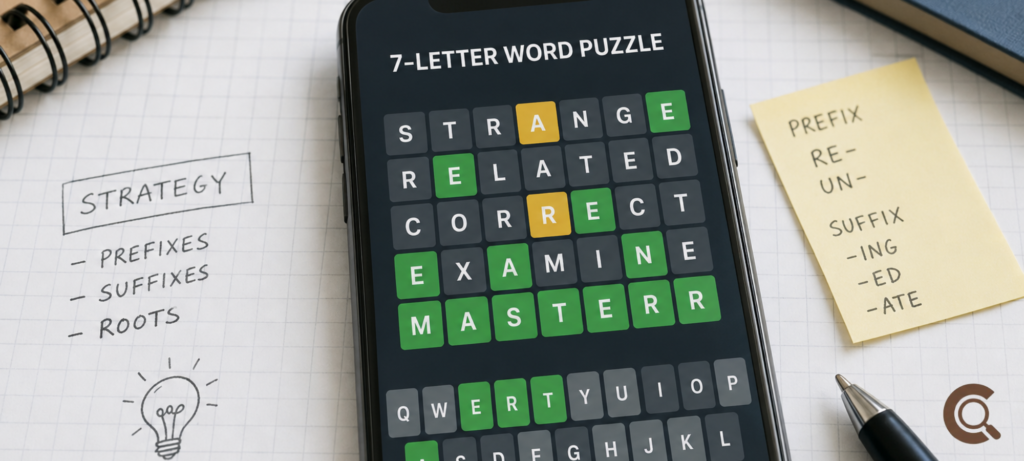
Daily word games have officially evolved. A few years ago, five-letter word challenges took over morning routines everywhere, turning quick coffee breaks into mental battlegrounds. But as solvers became more adept at spotting letter patterns, standard puzzles began to feel predictable.
Enter the 7-letter word puzzles daily challenge. Expanding a word grid by just two extra letters doesn’t just make a puzzle two steps longer—it dramatically expands the candidate word pool, introduces complex multi-syllable grammar rules, and forces players to adopt entirely new deduction strategies.
If you want to step up your daily game, transition from lucky guessing to logical deduction, and improve your solve rate, this comprehensive guide breaks down the core mechanics, structural secrets, and daily hacks needed to master seven-letter word puzzles.
The Rise of 7-Letter Word Puzzles: Why 5-Letter Games Aren’t Enough Anymore
Shorter word puzzles rely heavily on brute-force letter testing. With only five positions to fill, locking in two vowels and a common consonant often leaves you with just a handful of valid dictionary words.
Seven-letter puzzles change the dynamics completely.
The Cognitive Leap
When you move to a seven-letter format, the mathematical possibilities skyrocket. English contains significantly more seven-letter words than five-letter ones, which means letter placement demands genuine structural awareness rather than simple trial-and-error.
| Feature | Standard 5-Letter Puzzles | Advanced 7-Letter Puzzles |
| Typical Attempt Limit | 6 Guesses | 8 Guesses |
| Vocabulary Pool Size | Moderately Restricted | Expansive & Multi-Syllabic |
| Dominant Patterns | Standalone Vowels & Pairs | Prefixes, Suffixes, & Roots |
| Primary Skill Needed | Letter Elimination | Structural Pattern Recognition |
In longer puzzles, single letters rarely act in isolation. Instead, they operate in functional clusters—prefixes at the start and suffixes at the end—sandwiching a central root word. Recognizing how these blocks interact is the fastest way to shrink the search space.
Core Mechanics: Decoding Structural Patterns
To consistently solve 7-letter word puzzles in four or five attempts, you need to look at the board through the lens of word construction:
[ PREFIX ]  +  [ ROOT CORE ]  +  [ SUFFIX ]
 (UN-, RE-)     (3-4 Letters)    (-ATE, -ING)
1. Breaking Down High-Value Suffixes
In seven-letter English vocabulary, specific three-letter and four-letter endings appear with surprising regularity. Once you reveal yellow or green tiles for common suffix letters, testing these endings early can lock down the back half of your board immediately:
-ATE: Found in action verbs and descriptive adjectives (e.g., CREATE, RELATE, PRIVATE).-ING: The single most frequent suffix in seven-letter word pools.-ION/-TIO: Extremely common in noun structures.-ED/-ER/-EST: Standard comparative and past-tense modifiers.
If an A, T, and E turn yellow during your second guess, immediately test whether they form an -ATE ending rather than scattering them across the middle positions.
2. Spotting Common Prefixes
Just as suffixes guard the end of the board, prefixes dominate the first two to three positions:
UN-orDIS-: Reversal and negation prefixes.RE-orPRE-: Time and repetition indicators.CON-orSUB-: Structural framing prefixes.
Identifying a starting prefix like RE- alongside an ending like -ED leaves only three central letters to solve, effectively turning a complex seven-letter puzzle into an easy three-letter guessing game.
Step-by-Step Strategy: How to Solve in Fewer Tries
Solving daily puzzles efficiently isn’t about guessing full words right out of the gate; it’s about maximizing information gather per attempt.
       [ Guess 1: High-Density Opener ]
                      │
                      ▼
       [ Guess 2: Vowel/Consonant Map ]
                      │
                      ▼
       [ Guess 3: Suffix/Prefix Test ]
                      │
                      ▼
       [ Guess 4-5: Target Solution ]
Step 1: Deploy a High-Density Opener
Your opening word should cover five unique, high-frequency consonants alongside two common vowels. Ideal starters include:
STRANGE: Tests S, T, R, N, G alongside vowels A and E.ANOTHER: Covers N, T, H, R with a balanced spread of A, O, E.RELATED: Excellent for testing common ending structures and positions.
Step 2: Map Vowels and Consonant Clusters
By your second turn, aim to identify at least two vowels (A, E, I, O, U) and establish where key consonants like S, T, or R belong.
If your opener yields zero green tiles, don’t panic. A “zero green” result still provides critical elimination data by proving seven common letters are completely absent from today’s answer.
Step 3: Test Functional Clusters
Instead of randomly guessing individual positions, assemble your confirmed letters into known prefixes or suffixes. If I, N, and G are present, test them in positions 5, 6, and 7 before placing them anywhere else.
Advanced Tactical Hacks for Daily Solvers
When you find yourself stuck with only two guesses remaining, these practical tactical hacks can save your streak:
- Watch Out for Rare Letter Clustering: While letters like V, Z, X, and Q are statistically less frequent, they tend to appear unexpectedly. Furthermore, rare letters occasionally cluster across consecutive daily cycles. Never rule out an uncommon letter simply because it feels improbable.
- Leverage Double Letters: When common single-consonant options are exhausted, consider repeating letters like E, L, M, or T. Words like EMBLEM or COBBLE frequently catch players off guard because most openers prioritize unique letters over duplicates.
- Take a Strategic Break: Cognitive fatigue causes pattern blindness. If you’ve made four guesses without significant progress, walk away for fifteen minutes. Returning with fresh eyes allows your subconscious memory to spot word shapes you previously overlooked.
Expanding Your Brainpower: Practice Platforms and Related Challenges
To sharpen your deductive speed, diversifying your daily puzzle lineup is key. If you want to build a consistent habit, dedicated platforms offer a clean, distraction-free environment to test your skill.
When working on longer word lengths, testing your deduction skills on Septle provides an ideal daily training ground with structured seven-letter puzzles, six-letter bonus modes, and standard five-letter rounds.
If you ever get stuck on a particularly tough puzzle and want to double-check your deductions without ruining the fun, checking the daily hints on Septle Answer Today gives you progressive clues to guide you home.
Building a daily game habit isn’t just entertainment—it’s genuine cognitive exercise. Exploring a variety of Word Games That Improve Vocabulary helps strengthen verbal fluency, spatial awareness, and memory retention over time.
For players who enjoy contextual association and semantic deduction rather than spelling patterns, switching over to games like contexto provides a completely different type of linguistic challenge based on AI-driven word proximity.
Frequently Asked Questions (FAQ)
What is the single best starting word for a 7-letter puzzle?
Words like STRANGE and ANOTHER are widely considered optimal openers. They combine highly frequent consonants (S, T, R, N) with top-tier vowels (A, E, O), maximizing your chances of gathering actionable color feedback on turn one.
How do 7-letter puzzles differ from traditional 5-letter games?
While 5-letter games focus primarily on isolated root words, 7-letter word puzzles rely heavily on grammar structures such as prefixes (UN-, RE-) and suffixes (-ATE, -ING, -TION). They also feature eight attempts instead of six to accommodate the larger word pool.
What should I do if my first guess turns up zero matched tiles?
Treat a zero-match guess as a victory for elimination. Knowing seven high-frequency letters are entirely absent allows you to narrow down the remaining word pool dramatically on your second turn.
Conclusion: Level Up Your Daily Puzzle Routine
Mastering 7-letter word puzzles comes down to shifting your perspective. Instead of viewing a blank seven-space grid as an intimidating mystery, treat it as a combination of predictable linguistic building blocks.
By starting with high-density openers, looking for common prefixes and suffixes, and utilizing smart elimination tactics, you can consistently solve even the trickiest daily puzzles. Sharpen your strategy, protect your streak, and enjoy the mental workout!