
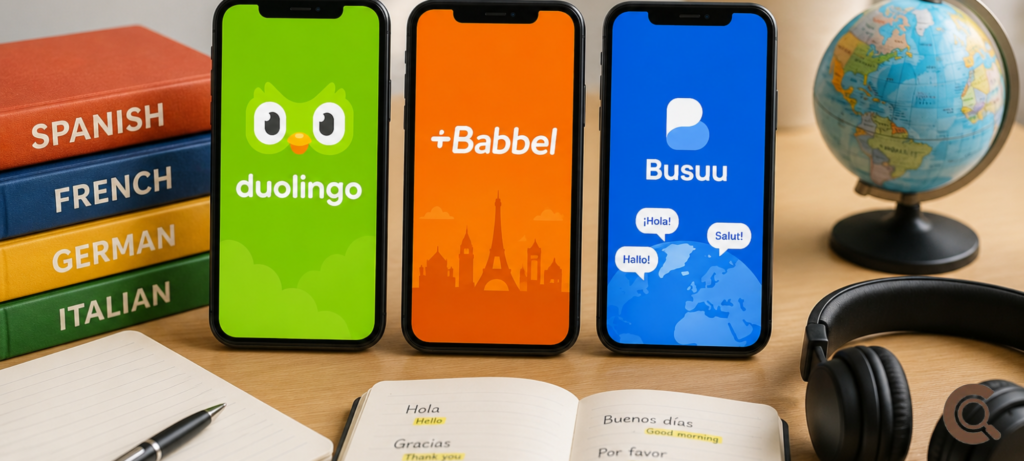
Open the App Store and search “learn Spanish” and you’ll get about forty apps thrown at you in half a second. So let’s cut through that. Duolingo vs Babbel vs Busuu is the comparison most people actually land on eventually, because these three keep coming up in every recommendation list, every Reddit thread, every “best apps of 2026” roundup. They’re not the same app wearing different logos, though. They teach very differently, and picking the wrong one for your personality is probably why you’ve quit a language app before.
The Short Version
Duolingo’s free, it’s fun, and it’s great at building a daily habit. Babbel costs money but teaches you grammar properly, so you can actually form sentences instead of just recognizing words. Busuu is the one with real humans — native speakers correct your writing and speaking, and you can walk away with an actual certificate. That’s the gist. Now here’s why it matters.
Duolingo: Good Habit, Shaky Foundation
Almost everyone’s used Duolingo at some point, mostly because it costs nothing and the owl won’t leave you alone about it. The whole app runs on gamification. Streaks, points, leaderboards against people you’ve never met and never will. Lessons take five or ten minutes, and they mix translation, word-matching, and listening exercises.
It works, honestly. People who’d never open a grammar textbook will happily keep a 300-day streak going just to not “lose” it. That’s not nothing.
But here’s where it falls apart for a lot of long-term users: Duolingo is great at vocabulary and pattern recognition, not so great at explaining why a sentence is built the way it is. You end up recognizing a hundred phrases but freezing the moment someone actually talks to you in real life. A lot of people describe hitting this exact wall around month four or five.
Babbel: Less Fun, More Actual Progress
Babbel goes the other direction entirely. It’s built by real linguists, and you can tell within the first lesson. Instead of random sentence fragments, you get situations you’d actually run into — ordering food, asking directions, getting through a job interview — and the app stops to explain the grammar behind it instead of assuming you’ll just absorb it eventually.
It’s not free, but it’s usually cheaper than Duolingo’s paid tier, and plenty of users say it gets them talking in usable sentences faster. The catch? It’s less game-like. If you need streaks and little celebration animations to stay motivated, Babbel can feel a bit dry next to Duolingo.
Busuu: The One With Real Feedback
Busuu sits in the middle, but it has something neither of the other two offers: an actual community of native speakers who review the sentences and audio you submit. You record yourself speaking, or write a short paragraph, and a real person who actually speaks that language tells you what’s wrong.
That’s a genuinely useful feature. It’s the closest thing to conversation practice you’ll get without paying a tutor by the hour. Busuu also hands out official certificates tied to CEFR levels, which some people need for job applications or study programs abroad. The lessons themselves land somewhere between Duolingo’s playfulness and Babbel’s grammar focus — not the most fun, not the most rigorous, but a solid middle ground.
Side-by-Side Comparison
| Feature | Duolingo | Babbel | Busuu |
|---|---|---|---|
| Price | Free (ads) / paid tier | Paid subscription | Free tier / paid subscription |
| Best for | Building a daily habit | Grammar and real conversation | Feedback from native speakers |
| Teaching style | Gamified, repetition-heavy | Situational, grammar-explained | Balanced, community-driven |
| Native speaker feedback | No | No | Yes |
| Official certificate | No | No | Yes (CEFR-aligned) |
| Offline mode | Limited, paid only | Yes | Yes |
| Where it’s strongest | Vocabulary recognition | Conversational fluency | Real-world writing & speaking |
So Which One Do You Actually Pick?
This really comes down to your personality more than anything the apps themselves are doing.
If money’s tight and you just need to build the habit of showing up daily, start with Duolingo. It’s free, and for a total beginner, the vocabulary exposure genuinely helps in the early weeks.
If you’re past the beginner stage and tired of knowing words but not being able to string a sentence together, pay for Babbel. The grammar explanations are worth the subscription.
If you want feedback that isn’t just an algorithm telling you “correct” or “incorrect,” and maybe a certificate to show for it, Busuu’s community feature is hard to beat.
A lot of people who actually get somewhere with a new language end up running two of these at once — Duolingo for the daily vocabulary grind, and Babbel or Busuu for the structure and feedback Duolingo just doesn’t offer.
It’s the Method, Not Just the App
Whichever app you pick, one thing stays true: these tools work best when you’re actively recalling information, not just scrolling through lessons half paying attention. It’s the same reason certain puzzle and brain-training apps actually build real skill over time instead of just feeling productive in the moment. If you want to understand why spaced, contextual review beats last-minute cramming — for a language or literally anything else you’re trying to learn — this piece on how memory actually works during learning covers it pretty well.
Quick Note on CEFR Levels
If you’ve noticed “A1,” “B2,” or “C1” floating around in any of these apps, that’s the Common European Framework of Reference for Languages — a standard scale used across Europe, and increasingly elsewhere, to describe how good you actually are at a language. Busuu leans on it the most because of its certificates, but it’s a useful benchmark no matter which app you’re using. “I finished level 12” doesn’t mean much to anyone outside the app. “I’m B1” does.
Frequently Asked Questions
Is Duolingo or Babbel better for beginners?
Duolingo’s easier to just jump into since it’s free and heavily gamified. Babbel becomes the better choice once you want to move past vocabulary and into actually forming sentences.
Is Busuu worth paying for?
If real feedback from native speakers and a certificate matter to you, yes. For casual daily practice, the free tiers of Duolingo or Busuu will usually get you by.
Can you actually learn a language with just one app?
You can make real progress, but most people who reach fluency eventually add something else — a language partner, a tutor, or just immersion through shows and podcasts in that language.
Which app has published the most research?
Duolingo, by a wide margin. They’ve put out a fair amount of public research on learning outcomes, which you can find on their official research page.
Will employers actually accept a Busuu certificate?
Some will, particularly where conversational ability matters more than a formal qualification. It’s always worth double-checking what a specific employer or program is actually looking for, though.
Final Thoughts
There’s no clean winner between Duolingo, Babbel, and Busuu — it depends entirely on what you’re trying to get out of it. Duolingo builds the habit. Babbel builds the grammar and the ability to actually talk. Busuu builds real feedback and something to show for your progress. If you’re serious about speaking the language and not just keeping a streak alive, pairing a structured app with steady daily practice is going to get you a lot further than betting everything on one app alone.