
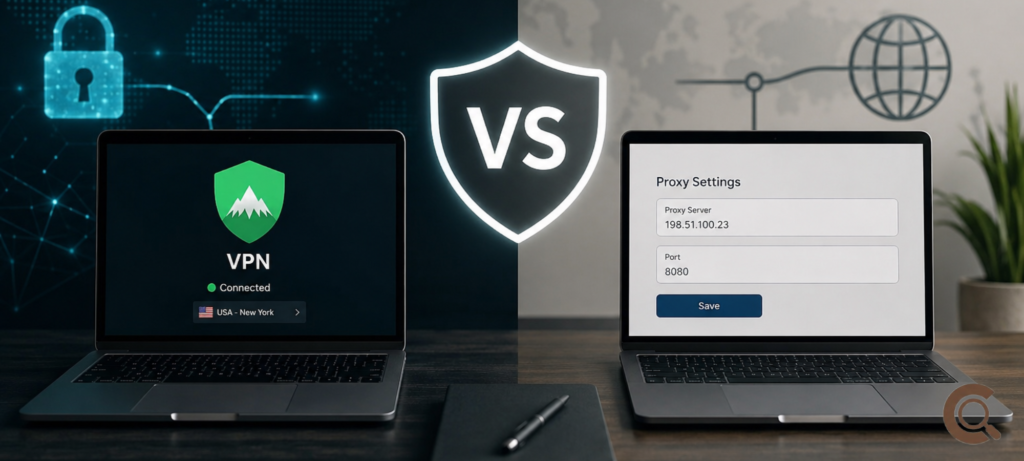
VPN vs Proxy is a comparison that comes up constantly whenever someone starts thinking seriously about online privacy, hiding their IP address, or getting around region-locked content. Both tools can make it look like you’re browsing from somewhere else. That’s about where the similarity ends, though. Once you dig into how each one actually handles your traffic — encryption, speed, security — the differences become pretty significant, and picking the wrong one for your situation can leave you a lot less protected than you think you are.
VPN vs Proxy: Quick Comparison
Here’s the short version before we get into the details:
| Feature | VPN | Proxy |
|---|---|---|
| IP masking | Yes | Yes |
| Encryption | Yes, full connection | Usually none |
| Security level | High | Low to Medium |
| Speed | Medium (encryption adds overhead) | Usually faster |
| Privacy | Strong | Limited |
| Setup | Easy, app-based | Depends on type |
| Best for | Full traffic protection | Quick IP switching |
VPN vs Proxy: Quick Answer — a VPN encrypts your entire internet connection and hides your IP address, while a proxy mainly changes your IP address without necessarily encrypting anything. If security and privacy are your main concern, a VPN is almost always the better pick.
What Is a VPN?
A VPN, or Virtual Private Network, creates an encrypted tunnel between your device and a remote server. Every bit of traffic leaving your phone or laptop — browsing, app data, background sync — gets routed through that tunnel before it touches the open internet. Because the tunnel is encrypted, anyone watching the connection from outside (your ISP, someone on the same public Wi-Fi, a nosy network admin) just sees scrambled data.
Most VPN apps today use tunneling protocols like OpenVPN or WireGuard, both of which balance speed with strong encryption. You install an app, tap connect, and the whole device’s traffic gets covered — not just your browser. That’s a meaningful distinction, because a lot of privacy leaks happen through background apps that people forget are even sending data.
What Is a Proxy Server?
A proxy server works more like a middleman for specific traffic. When you connect through a proxy, your requests get forwarded through that server, and websites see the proxy’s IP address instead of yours. That’s genuinely useful for things like checking how a website looks from another country, or routing traffic for a single app or browser tab.
What a proxy usually doesn’t do is encrypt your data. Your traffic passes through the proxy server largely as-is, which means the proxy operator — and potentially anyone snooping between you and them — can see what you’re sending. Free proxies in particular are worth being cautious about, since some log and sell user traffic data as their actual business model.
VPN vs Proxy: Key Differences Explained
The difference between VPN and proxy really comes down to four things: encryption, scope, speed, and trust.
Encryption is the big one. A VPN wraps your entire connection in a layer of encryption; a proxy typically doesn’t touch encryption at all. Scope matters too — a VPN protects everything leaving your device, while a proxy is often configured per-app or per-browser, so anything outside that scope stays exposed.
Speed tends to favor proxies, since there’s no encryption overhead slowing things down. That’s fine if you just need a quick IP switch for something low-stakes. But if you’re on airport Wi-Fi checking your bank balance, that speed advantage isn’t worth much if your data isn’t protected.
Trust is the part people overlook. With a VPN, you’re trusting the VPN provider not to log your activity — which is why checking a provider’s logging policy actually matters. With a proxy, you’re trusting the server operator with your raw, often unencrypted traffic, which is a bigger ask than most people realize.
Is a Proxy Safer Than a VPN?
Generally, no. Most proxies don’t encrypt your connection, while VPNs are built around encryption as a core feature. A proxy can hide your IP address from the websites you visit, but it typically won’t stop your ISP or anyone on the same network from seeing what you’re actually doing online.
That said, “safer” depends on what you’re protecting against. If your only goal is to appear as though you’re browsing from a different city for a quick site check, a proxy does that job fine without any real downside. The moment sensitive data is involved — logins, payment info, personal messages — the gap between the two gets a lot more important.
VPN vs Proxy for Privacy: Which Wins?
For privacy specifically, VPN wins by a wide margin. A well-configured VPN prevents your ISP from seeing which sites you visit, blocks a lot of common tracking methods tied to your IP address, and keeps your data unreadable even if it’s intercepted.
Proxies don’t offer the same protection against ISP tracking, since your ISP can usually still see the unencrypted traffic passing through their network before it reaches the proxy server. If data logging and long-term anonymity matter to you — not just IP masking for a single session — a VPN is doing considerably more work behind the scenes.
When Should You Use a Proxy Instead of VPN?
Proxies aren’t obsolete, they’re just suited to narrower jobs. A few situations where a proxy makes sense:
- Checking how a website renders or ranks from a different country
- Quick, low-risk browsing where speed matters more than privacy
- Automated tasks like web scraping, where a full VPN tunnel would just add unnecessary overhead
- Bypassing a simple geo-restriction on non-sensitive content
If none of that describes what you’re doing, and you’re dealing with anything remotely personal or financial, a VPN is the safer default.
VPN or Proxy Which Is Better?
It depends on who’s asking.
Casual browsers who just want a bit more privacy day-to-day are usually better off with a VPN — it’s set-and-forget once installed, and it covers the whole device.
Business users handling client data or remote work over public networks should treat VPN as close to mandatory rather than optional.
Travelers juggling airport and hotel Wi-Fi are exactly the audience a VPN was built for — that “imagine you’re on airport Wi-Fi” scenario is the textbook case where a proxy leaves you exposed and a VPN doesn’t. Beyond travel, protecting personal data online matters just as much on a phone at home, and the same encryption logic applies there too.
Gamers sometimes lean toward proxies for lower latency in specific situations, though a fast VPN server can often get close enough without sacrificing security.
Privacy-focused users should go with a VPN, full stop — ideally one with a clearly published no-logs policy.
VPN Alternatives: Are There Other Options?
Beyond VPNs and proxies, a few other tools show up in the same conversation. Tor Browser routes traffic through multiple volunteer-run relays, offering strong anonymity but at a real cost to speed — it’s built for anonymity first, convenience a distant second. A firewall doesn’t mask your IP at all, but it controls what traffic is allowed in and out of your device, which complements a VPN rather than replacing it. And simply making sure you’re only visiting HTTPS sites adds a baseline layer of encryption for that specific connection, even without any of the above.
None of these fully substitute for a VPN if your goal is broad, always-on protection, but they’re worth knowing about depending on what you’re trying to solve.
Frequently Asked Questions
What is the difference between VPN and Proxy? A VPN creates an encrypted tunnel between your device and the internet, protecting all your traffic. A proxy only routes specific traffic through another server to hide your IP address, usually without encrypting it.
Is a proxy safer than a VPN?
Generally, no. Most proxies don’t provide encryption, while VPNs protect your traffic using encryption protocols like OpenVPN or WireGuard, making them the stronger choice for sensitive activity.
VPN or Proxy — which is better for privacy?
A VPN is better for privacy because it encrypts your connection end-to-end and limits many common forms of ISP tracking, while a proxy mainly masks your IP address without protecting the data itself.
When should you use a proxy instead of a VPN?
A proxy works well for simple IP switching, checking region-specific content, or lightweight browsing tasks where encryption isn’t a priority. For anything involving personal or financial data, a VPN is the safer option.
Are free proxies safe to use?
Not always. Some free proxies log or sell user traffic since they need to fund the service somehow. If you’re using one, avoid logging into sensitive accounts through it.
VPN vs Proxy Difference in One Sentence
A VPN encrypts your entire internet connection, while a proxy mainly changes your IP address without full encryption.
Conclusion
When you break down VPN vs Proxy, it’s not really a matter of one being universally “better” — it’s about matching the tool to what you’re actually trying to protect. A proxy is fine for quick, low-stakes IP switching. A VPN is the stronger choice the moment real privacy, encryption, or sensitive data enters the picture. For most people doing everyday browsing, banking, or work over public networks, a VPN is worth the small speed trade-off. If you’re also cleaning up your setup in general, pairing good browsing habits with improving PC security and performance rounds out the basics — a VPN protects your connection, but a well-maintained system protects everything else.
Further reading on how encryption and privacy tools actually work: Mozilla’s guide to VPNs and Cloudflare’s Learning Center on VPNs