
Looking for the full searchable list of every past answer, difficulty rating,
and puzzle number? Visit our What Is the Contexto Archive? for the complete
database. This guide takes it a step further — it shows you exactly how to
use that archive as a training tool to get measurably better at the game.
The archive is not just a historical record. It is a training library. Every past puzzle is a complete, ready-to-play Contexto game with a known secret word. Intentionally playing through them regularly produces faster skill improvement than almost anything else you can do in this game.
This guide covers how the archive works, how to access it, what it contains, and how to use it strategically to get measurably better at the daily puzzle.
What Is the Contexto Archive?
Every past Contexto puzzle is a complete, replayable game with a known
secret word. That makes the archive far more than a lookup tool — it is
a training library you can use to sharpen your semantic thinking anytime,
without waiting for a new puzzle to drop.
The sections below cover how to access it and, more importantly, how to
actually use it to improve.
The archive serves two distinct purposes:
- Playability: It lets you play any past puzzle as if it were brand new. The game interface loads the secret word for that specific date and ranks your guesses against it exactly as it would have on the original day.
- Reference: It gives you a database for looking up past answers, checking historical difficulty trends, and understanding the linguistic scope of the game.
The reference archive on this site is updated daily as each new puzzle is added to the record.
How to Access the In-Game Archive
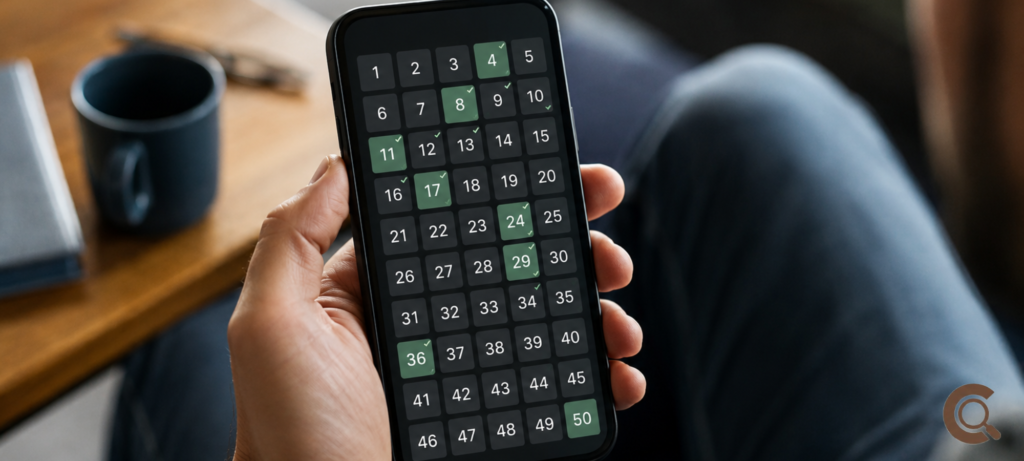
The game has a built-in feature that lets you dive back into game history. To access it, tap the Play Archive button on the main game screen. This opens the archive modal—a scrollable list of all past daily puzzles sorted by date, with the most recent appearing first. Each entry shows the date and puzzle number. Simply tap any entry to load that puzzle and start playing.
When you load an archive puzzle, the game switches from Daily mode to archive mode for that session. Everything works exactly as it does in Daily mode: you get unlimited guesses, the same numerical rank feedback, the same hint system, and the same scoring mechanics.
The archive software only shows puzzles up to and including today’s date. Future dates are hidden, completely removing the accidental spoiler problem that players encountered in earlier versions of the game.
The Answer Archive vs. The In-Game Archive
There are two distinct archive experiences available to players, and they serve completely different purposes.
| Feature | The In-Game Archive | The Answer Archive |
| Where to Find It | Inside the main game interface via the “Play Archive” button. | Online reference database. |
| Primary Purpose | Active gameplay and tactical practice. | Learning, benchmarking, and quick lookup. |
| What It Shows | An interactive guessing board matching historical parameters. | Past answers, community average guess counts, difficulty ratings, and semantic clusters. |
| Best Used For | Catching up on missed days and testing specific strategies. | Studying why a past word was hard and identifying linguistic trends. |
Using both of these tools together—such as playing a past puzzle blindly and then immediately reviewing its dedicated data page—is the most effective way to train your semantic intuition.
Five Ways to Use the Archive to Improve Your Game
1. Play Hard Past Puzzles Deliberately
Look through the online answer database for puzzles with high average guess counts—specifically those that took the community an average of 40 or more rounds to solve. Loading these tough matches gives you a low-stakes environment to face complex words, with the data breakdown available to study as soon as you finish.
2. Targeted Category Practice
If you consistently hit a wall when dealing with abstract words, emotion-based terms, or material-based vocabulary, search the historical database for those specific word types. Deliberately seeking out your weak areas builds the contextual pattern recognition you need to survive unexpected daily puzzles.
3. Test Your Opening Sequence Consistency
Use the archive to run 10 consecutive past puzzles using the exact same starting words every single time. Track how your openers perform across entirely different secret word categories. This gives you concrete data on whether your launch strategy is universally effective.
For a breakdown of which starting words statistically yield the lowest numerical ranks, check out our opening words guide.
4. Catch Up on Missed Days Without Streak Pressure
If you miss a calendar day, the archive lets you experience the puzzle you skipped. While playing an archived match won’t restore a broken daily consecutive streak, it does allow you to maintain your mental momentum and daily learning habits.
5. Post-Mortem Review Sessions
After struggling through a grueling daily puzzle, load that same puzzle from the archive a few hours later. Knowing the answer ahead of time allows you to trace the semantic path backward. You can visually map which directions were genuinely warm and which ones were misleading detours, sharpening your intuition for future games.
What the Data Reveals About Word Selection
Analyzing hundreds of past puzzles reveals clear patterns in how the game’s engine selects its targets:
- Curated Category Variety: The game balances its vocabulary over time. Animals, nature, food, materials, abstract concepts, actions, and emotions all appear with calculated regularity to ensure no single field dominates the board for too long.
- Difficulty Clustering: High-difficulty puzzles rarely appear back-to-back. After a notoriously brutal word breaks player streaks, the engine typically follows up with a more accessible, concrete noun the next day to keep the experience engaging.
- The Deception of Familiar Words: Some of the most challenging archive puzzles feature ordinary, everyday words. Because the underlying AI maps real-world language usage rather than human logic, common words often have sprawling, highly industry-specific semantic neighborhoods that throw players off track.
Using Archive Puzzles as a Performance Benchmark
The archive allows for systematic self-benchmarking. Because historical puzzles are fixed, they function as repeatable test environments to measure your cognitive growth over time.
To set up a benchmark test:
- Choose five past puzzles across varying difficulty levels (two easy, two medium, one hard).
- Record your total guess count for each one today.
- Save those numbers, wait four weeks, and replay those exact same five puzzles.
- Compare the data.
If your solve counts drop significantly, your semantic mapping skills have genuinely improved. If your numbers remain stagnant, it is a clear indicator that your opening sequences or category pivoting techniques need an overhaul. For a deeper look at refining your long-term approach, our comprehensive strategy guide provides actionable blueprints for advanced players.
This structured approach is backed by educational science. According to research from the Cambridge Assessment group on game-based learning, combining deliberate practice with active performance review produces significantly stronger skill retention in complex cognitive tasks than unstructured repetition alone.
Frequently Asked Questions
Does playing archive puzzles count toward my active streak?
No. Daily streaks are based entirely on completing the live puzzle on the specific calendar day it drops. Archive puzzles do not impact your streak stats in either direction.
Can I see which archive puzzles I have already completed?
Yes. In the built-in game archive menu, a small checkmark or completion indicator appears next to every past puzzle you have successfully solved, making it easy to track your progress.
Is there a limit to how many historical puzzles I can play?
There are no restrictions or daily limits. You can play as many past puzzles as you want. The catalog grows by exactly one game every day.
Does replaying the same archive puzzle twice give different results?
No. The secret words and their mathematical proximity values are pre-calculated and entirely static. Typing the same word on the same archive puzzle will always yield the exact same numerical rank.