
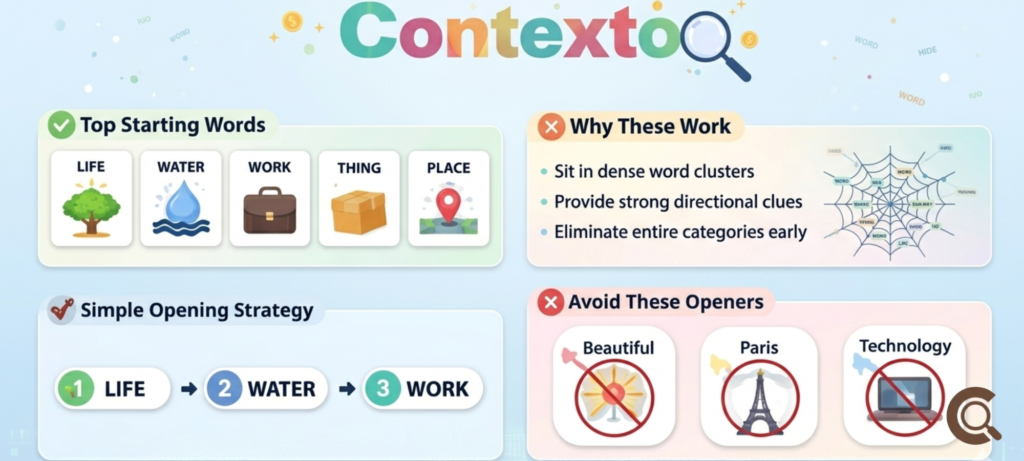
Your opening guess in Contexto is the most important move you make in the entire game. Not because it is likely to score brilliantly — it usually will not — but because it sets the direction for everything that follows. A strong first guess gathers intelligence. A weak one wastes a turn and gives you almost nothing to work with.
After analysing hundreds of Contexto puzzles and observing which words consistently return useful rank data, we have put together this guide to the most effective starting words available. Whether you are a complete beginner or someone who has been playing for months and wants to sharpen their approach, this breakdown will change how you open each game.
Why Your Starting Word Matters So Much
Contexto operates on word embeddings. Every word in the model occupies a position in a high-dimensional space, and words that appear frequently in similar contexts are positioned close together. When you type a guess, the game tells you how far your word sits from the secret word in that space.
A good starting word should sit near the centre of a large, heavily populated semantic cluster. That way, whatever rank you receive gives you meaningful directional information. If a central word scores poorly, you know the answer lives in a distant cluster. If it scores well, you are already in the right neighbourhood.
A bad starting word is one that is either too obscure (rare words occupy isolated positions in the model and their ranks tell you little) or too specific (a highly technical term will only score well if the answer happens to be in that niche).
The goal is maximum information per guess. Think of it less like guessing and more like triangulation.
The Top Starting Words by Category
Category 1 — Ultra-Broad Abstract Nouns
These words appear in an enormous variety of sentences across all types of text. Their semantic neighbourhood is so wide that they tend to return moderate ranks for a huge number of possible answers, which tells you a lot about general direction.
Thing — Perhaps the most semantically neutral word in English. It connects to almost everything, which means its rank tells you how close you are to the general category of the answer. A rank below 500 with “thing” suggests a concrete, common object.
Place — Covers locations, rooms, cities, landscapes, and conceptual spaces. If “place” scores well, the answer is likely something geographic, architectural, or positional.
Person — Useful for pulling in words related to human beings, roles, occupations, and relationships. Strong opener when you suspect the answer might be a job title or a type of individual.
Life — One of the most semantically rich words in the English language. It connects to biology, time, experience, living things, and abstract concepts. A solid general opener.
World — Covers global, environmental, social, and abstract themes. Good at distinguishing between words that are broadly human-facing versus narrowly technical.
Category 2 — High-Frequency Concrete Nouns
These words are everyday objects or ideas that appear millions of times across the internet, books, and conversation. They sit in dense, well-mapped areas of the semantic model.
Water — Connects to nature, drinking, weather, oceans, science, and daily life. Consistently one of the most useful second or third guesses in any puzzle.
House — A strong opener for puzzles where the answer relates to domestic life, objects, rooms, or family. The semantic cluster around “house” is enormous and well-distributed.
Time — Exceptionally broad. Connects to clocks, seasons, history, schedules, music, and measurement. Good for identifying abstract or temporal answers.
Food — When you suspect the answer might relate to eating, cooking, flavours, or meals, “food” as an opener maps out the entire cluster quickly.
Work — Covers employment, effort, creation, machinery, and professional life. A reliable opener that distinguishes between answers in the activity cluster versus the object cluster.
Category 3 — Strategic Pivot Words
These are words you use after your first one or two guesses have given you some directional information. They help you narrow from a general cluster to a specific sub-cluster.
Nature — If your early results suggest the answer is something outdoor or biological, “nature” will tighten your range significantly.
Body — Excellent pivot word when your guesses are returning good ranks for anatomical or health-related words.
School — Useful when your opening guesses suggest an educational or childhood theme. The school cluster includes learning, reading, childhood, teachers, and knowledge.
Animal — If “dog,” “cat,” or any wildlife-related word scores in the green, switch to “animal” as a pivot to confirm you are in the right zone.
Words That Sound Good But Rarely Work Well
There are certain words players gravitate toward that actually underperform as openers. Understanding why helps you avoid the trap.
Unique — Too abstract in a way that is not useful. Its semantic neighbours are mostly adjectives describing quality or rarity, which do not map onto the diverse range of Contexto answers.
Beautiful — Similar problem. Adjectives make poor starting words because their semantic cluster is dominated by other adjectives and aesthetic concepts, which represent only a small slice of possible answers.
Technology — Sounds broad but is actually quite specialised. Unless you already suspect the answer is tech-related, this opener boxes you into a narrow cluster too early.
Random proper nouns — Names of people, places, or brands almost never appear as Contexto answers, and their embeddings tend to be isolated from common vocabulary. Starting with “Paris” or “Shakespeare” wastes a guess.
A Recommended Opening Sequence
Based on consistent puzzle analysis, here is a reliable three-guess opening sequence that covers a wide area of the semantic map and gives you strong directional information regardless of what today’s word turns out to be.
Guess one: LIFE. This establishes whether the answer is in the living, experiential, or abstract zone.
Guess two: WATER. This covers nature, science, and the physical world. Combined with the result from “life,” you now have two data points to triangulate.
Guess three: WORK. This covers the activity and professional world. If neither “life” nor “water” scored particularly well but “work” does, you know the answer is action-oriented or professional in nature.
From those three results, most experienced players can identify which broad cluster the answer lives in and pivot accordingly. According to linguistic research published by the Princeton WordNet project, English nouns cluster into approximately twelve major semantic domains. Three well-chosen guesses can rule out half of those domains entirely.
How to Adapt Your Openers Over Time
Your starting word strategy should evolve as you play more puzzles. Keep a simple log of which openers gave you the most useful information in recent games. If you notice that “house” consistently gets you into the green quickly, that might reflect a pattern in the current puzzle set — or simply that your personal vocabulary connects well to domestic themes.
The best Contexto players treat each game as a small experiment. You are testing hypotheses about where in semantic space the answer lives. Over weeks of play, you develop an intuition for which parts of the map the puzzle creators tend to favour, and your openers naturally become more targeted.
For more advanced strategy on how to handle difficult puzzles, our guide on how to get better at Contexto walks through the mid-game and endgame phases in detail.
You can also explore the technical side of why certain words cluster together by reading about word embedding models on Wikipedia, which provides a genuinely accessible explanation of the underlying technology without requiring a computer science background.
The One Mindset Shift That Changes Everything
The most important thing to remember about starting words — and about Contexto in general — is that you are not trying to guess the answer on turn one. You are trying to gather intelligence. Every guess, especially the early ones, is an investment in information.
Players who approach the game with that mindset stop feeling frustrated by early red results. A red rank on a well-chosen opener is not a failure. It is useful data that eliminates an entire region of the semantic map. The faster you can eliminate regions, the faster you converge on the answer.
Pick your openers deliberately, read the rank results carefully, and treat the first five guesses as your mapping phase. The answer will come.
Ready to put this into practice? Head to contexto.uk and try today’s puzzle with your new opening strategy.