
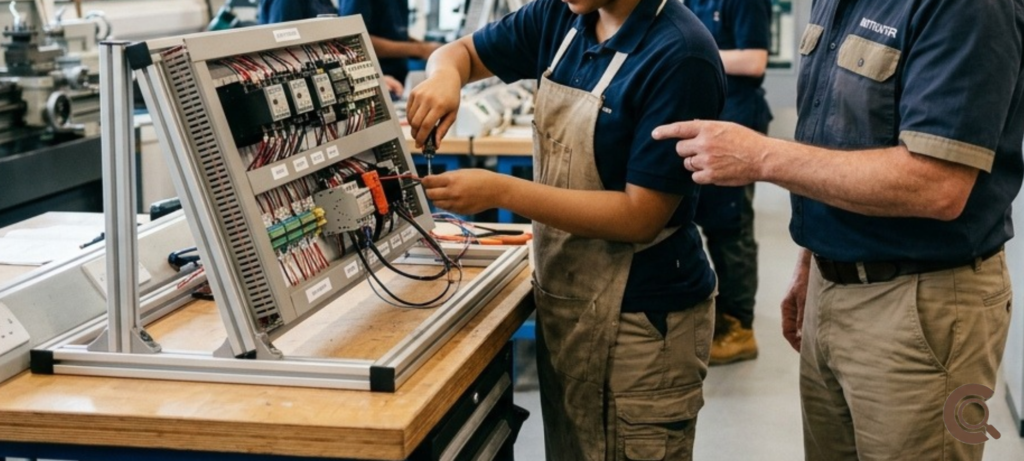
Traditional classrooms work well for many students, but they are not the only environment where learning happens effectively. Some students understand a concept much faster once they can see it, handle the equipment, solve a real problem, and connect the lesson to a practical result.
That is where hands-on career training can make a major difference.
Technical programs, vocational courses, apprenticeships, and career-focused education give students opportunities to develop skills that are difficult to learn from textbooks alone. The value is not simply preparing someone for a specific job. Practical training can also improve confidence, problem-solving, communication, and the ability to work safely and independently.
For students who struggle to see the purpose behind purely academic lessons, applying knowledge to real tasks can make education feel much more relevant.
Real Equipment Makes Lessons Easier to Understand
There is a major difference between reading how a machine works and actually using one.
Career training gives students the opportunity to understand equipment, tools, maintenance, and procedures in a real working context. A student learning about industrial cleaning, for example, can better understand pressure, equipment setup, maintenance needs, and job-site preparation by studying the types of systems supplied through businesses such as hotsysouthtexas.com and then connecting those concepts to practical training.
The same applies across automotive work, construction, electrical trades, culinary programs, healthcare training, and many other fields.
Hands-on experience turns abstract information into something visible. Instead of memorizing a sequence because it might appear on a test, students begin understanding why each step matters.
That connection can make the information easier to remember long after the course is finished.
Students See the Purpose Behind What They Are Learning
A common source of frustration in school is the question: “When am I ever going to use this?”
Career-focused education provides an answer.
Math becomes more meaningful when it is needed to measure materials, calculate costs, or interpret specifications. Reading skills matter when following technical manuals. Communication matters when working with customers, supervisors, and teammates.
Even subjects that appear theoretical begin to feel more practical once students can see where they are used.
That does not make traditional academic subjects unimportant. In fact, hands-on training often shows why those subjects matter.
Students who previously struggled to engage may become more motivated when classroom knowledge is tied directly to a task they want to complete.
Learning starts feeling less like a requirement and more like a tool.
Mistakes Become Part of the Learning Process
Practical training creates opportunities to make controlled mistakes and learn from them.
That is valuable because many workplace skills cannot be fully understood until something goes wrong. A measurement may be inaccurate, equipment may be set up incorrectly, or a process may produce a result that does not meet expectations.
Under proper supervision, students can examine what happened and correct it.
This develops problem-solving skills in a way that a multiple-choice question often cannot.
Instead of simply being told that an answer is wrong, students have to identify why the result failed and what should change next time.
That process encourages patience and attention to detail.
It also teaches an important workplace lesson: problems are not always solved by starting over. Sometimes the real skill is recognizing what went wrong early enough to fix it efficiently.

Career Training Builds Confidence Through Competence
Confidence becomes more meaningful when it is based on something a student can actually do.
Completing a practical task provides visible evidence of progress. A student can repair something, prepare a finished product, operate equipment correctly, complete an installation, or solve a technical problem that once seemed difficult.
Those achievements can be particularly powerful for students who have not always felt successful in traditional academic settings.
They begin seeing themselves as capable learners rather than assuming they are simply “bad at school.”
This confidence can carry into other areas. Once students understand that improvement comes through repetition and practice, they may become more comfortable asking questions, accepting feedback, and attempting unfamiliar tasks.
Practical competence creates momentum.
Safety Becomes More Than a List of Rules
Workplace safety is difficult to teach effectively through theory alone.
A student can memorize that protective equipment matters, but practical training shows exactly when and why it is needed. They can see how poor setup, rushing, incorrect tool use, or a messy workspace can create problems.
Supervised practice also helps safe habits become automatic.
Students learn to inspect equipment before use, organize the work area, follow procedures, and think ahead before beginning a task.
That mindset is valuable in almost every career field.
Good safety training is not about making students afraid of equipment. It is about helping them become confident enough to use it correctly while respecting the risks involved.
The earlier those habits are developed, the easier they are to carry into professional environments.
Students Learn How Work Actually Happens
Jobs rarely involve completing one isolated task from beginning to end without interruption.
There are deadlines, teammates, changing priorities, customer questions, equipment problems, and decisions about what should happen first.
Career training can introduce students to that reality.
Group projects teach communication and responsibility. Practical assignments require time management. Simulated workplace situations can teach students how to respond when a plan changes.
Students also begin understanding professional expectations that are difficult to capture in a textbook.
Showing up prepared matters. Keeping tools organized matters. Explaining a problem clearly matters. Finishing a task properly matters.
These habits can be just as important to early career success as the technical skill itself.
Practical Training Can Open More Than One Career Path
Career education does not have to lock a student into one profession forever.
In many cases, it does the opposite.
Learning to use tools, understand mechanical systems, troubleshoot equipment, follow technical instructions, or work with customers can transfer across several industries.
Someone who begins with one trade may later move into supervision, sales, equipment servicing, training, business ownership, or another technical field.
Hands-on programs also give students an opportunity to test whether they actually enjoy a type of work before making a larger commitment.
That experience can prevent someone from choosing a career based only on an idea of what the job is like.
Career training therefore provides both skills and information about personal preferences.
Education Works Better When There Is More Than One Route
Not every student should be expected to learn in exactly the same way or pursue the same type of career.
Some thrive in academic environments and want to continue into university. Others become much more engaged when learning is connected to equipment, projects, customers, or visible results.
Both routes can require intelligence, discipline, and continued learning.
The important thing is giving students enough options to discover where their strengths become useful.
Hands-on career training can turn education into something concrete. It allows students to practice, make mistakes, solve problems, and see improvement directly.
For many learners, that experience can be the moment when education finally starts to feel connected to the future they actually want.