
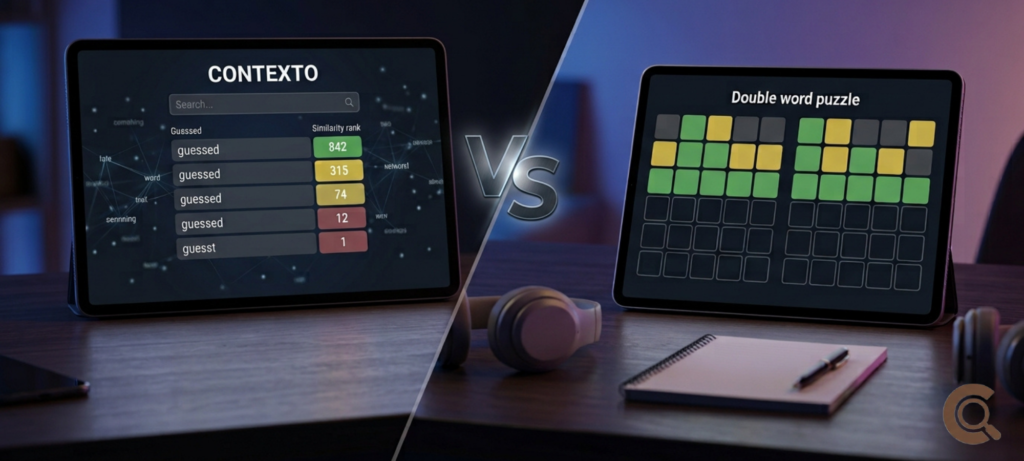
Contexto vs Dordle is really a choice between two very different ways of thinking about words. Contexto asks you to follow meaning, association and context until you reach one hidden word. Dordle asks you to manage letters, positions and two five-letter answers at the same time.
Both games fit neatly into a daily puzzle routine. Both reward vocabulary, patience and good guesses. Yet the feeling of solving them is completely different. In Dordle, every turn is a small logic problem: which letters are confirmed, which positions are blocked, and which of the two boards deserves attention next? In Contexto, there is no grid to rescue you. You have to work outward from broad ideas, then slowly narrow the semantic neighbourhood around the answer.
If you enjoy Wordle-style letter deduction but want more pressure, Dordle is a natural next step. If you prefer exploring how ideas connect rather than testing spelling patterns, Contexto is likely to be the more satisfying challenge. You can also see how a semantic game differs from a traditional letter puzzle in our detailed Contexto vs Wordle comparison.
Contexto vs Dordle: How the Two Games Actually Work
The simplest difference is this: Contexto is a meaning game, while Dordle is a letter-position game.
In Contexto, you type a word and receive a numerical rank. The closer that number is to 1, the closer your guess is in meaning or context to the secret word. You might guess “river” and discover that it is unusually close, even though the answer is not a synonym such as “stream.” The target could be connected through places, activities, objects, emotions or common language patterns. The puzzle becomes a process of asking: What kind of world does this word belong to?
Dordle uses a much more familiar visual system. A single five-letter guess appears on two separate boards. Each board gives its own letter feedback:
- Green means the letter is correct and in the correct position.
- Yellow means the letter is in that word, but in the wrong position.
- Gray means that letter is not part of that board’s answer.
The common version of Dordle gives players two hidden words and seven shared attempts. One guess affects both boards, so a word that looks useful on the left may offer almost nothing on the right. Dordle’s own game description presents it as a free two-board challenge with seven attempts and colour-based clues.
That shared-guess mechanic is where the pressure comes from. You do not get seven attempts for each answer. You have seven total turns to solve both. A great opening word can reveal useful vowels and consonants across the two boards; a narrow guess can waste a precious turn if it helps only one side.
Contexto does not usually put that kind of hard limit on the player. You can make many guesses, which changes the challenge from “Can I solve this quickly enough?” to “Can I discover the right semantic direction?” The game is less about conserving attempts and more about recognising patterns in language.
There is another practical difference: Dordle answers are generally short, fixed-length words, while Contexto can lead players toward a much wider range of concepts. A Dordle session may end with words such as crane and piano. A Contexto session may move through clusters such as music, concert, guitar, stage and singer before landing on the answer.
For that reason, Contexto often feels more open-ended. Dordle feels tighter, cleaner and more tactical.
The Skills Each Puzzle Rewards
Dordle rewards efficient information gathering. The first one or two guesses should usually test common vowels and frequent consonants without repeating too much information. You are not trying to solve either board immediately. You are trying to reveal enough letter data to make the next few turns intelligent.
Suppose an early Dordle guess gives you an A and R in useful positions on the left board, but shows that neither letter belongs on the right. You now have two separate problems. One board needs refinement around A and R; the other needs a fresh letter set. Players who can keep both sets of clues organised usually perform better than players who chase one nearly solved word too early.
Dordle also rewards visual discipline. It is easy to look at one yellow letter and forget that it belongs only to one board. A letter can be green on the left and completely gray on the right. Reading both boards independently is essential.
The basic letter-feedback system comes from the same broad family of word puzzles made famous by Wordle. The New York Times explains that Wordle uses five-letter guesses and colour feedback: green for the correct letter in the correct place, yellow for a correct letter in the wrong place, and gray for a letter that is absent. The New York Times’ Wordle help guide describes those rules in detail.
Contexto rewards a different kind of discipline: avoiding random guessing. When a word lands in a relatively strong rank, the best response is not to throw unrelated words at the puzzle. It is to explore the semantic cluster around that word.
Imagine that “garden” is your best Contexto guess. You might test “flower,” “plant,” “soil,” “park,” “lawn,” “nature,” “greenhouse” or “seed.” These guesses are not identical in meaning, but they belong to nearby contexts. If “soil” suddenly ranks much closer than “flower,” you have learned something important: the answer may be more connected with land, farming or ground than with decoration or plants.
That is why Contexto can feel rewarding even when you are not close to rank #1. Each strong rank can reveal a new direction. The game gives you a map, but the map has no labels.
If you want to improve that process, read our practical guide on how to get better at Contexto. It explains how to move from broad opening guesses into useful semantic clusters without wasting too many turns.
Which Game Feels Harder?
There is no universal winner because the games create difficulty in different ways.
Dordle feels harder when you dislike time pressure, limited guesses or managing two pieces of information at once. Seven attempts may sound generous compared with Wordle’s six, but two boards make that extra guess disappear quickly. You can make a promising start and still lose because the second word remains stubbornly unclear.
Contexto feels harder when you want concrete clues. A yellow tile tells you something precise: the letter exists, but it is in the wrong place. A semantic rank can be more ambiguous. If your guess is ranked #245, you know you are somewhere in the right area, but you still need to decide which relationship matters. Is it a synonym? An object commonly found nearby? A profession? An action? A cultural association?
The harder game therefore depends on the player:
| If you enjoy… | You may prefer… | Why |
|---|---|---|
| Letter patterns, spelling and elimination | Dordle | Every guess gives visible positional evidence |
| Association, vocabulary and lateral thinking | Contexto | Meaning matters more than spelling |
| Short, high-pressure daily sessions | Dordle | Two boards and seven shared turns create urgency |
| Exploring a puzzle without a strict attempt limit | Contexto | You can investigate a semantic trail over time |
| Logic grids and structured deduction | Dordle | The board narrows possibilities clearly |
| Unexpected connections between ideas | Contexto | The answer can emerge through context rather than definition |
A useful way to frame Contexto vs Dordle is this: Dordle tests whether you can filter possibilities. Contexto tests whether you can generate possibilities.
That distinction matters. In Dordle, a guess is valuable when it removes letters and confirms positions. In Contexto, a guess is valuable when it gives you a stronger conceptual clue. The two games may both involve words, but the mental journey is not the same.
Semantic Thinking Versus Letter Logic
Contexto has an advantage for players who enjoy discovering relationships between words. It encourages you to think beyond dictionary definitions. A word can be close to the answer because people often use both words in similar situations, not simply because they mean the same thing.
This idea is related to how semantic language models represent words. In computational linguistics, word-vector approaches place words into mathematical spaces based on patterns of co-occurrence. Stanford’s GloVe project explains that word representations can be learned from global word-word co-occurrence statistics and then used to examine relatedness between terms.
That does not mean players need to understand machine learning to enjoy Contexto. It simply explains why guesses can surprise you. A word such as “candle” may lead toward a secret answer through associations with light, birthdays, religion, romance, wax or fire. The strongest next guess is often not the closest dictionary synonym; it is the word that shares the most useful context.
Dordle does not ask for that kind of semantic leap. It asks a more concrete question: what five-letter word can fit the evidence on the board? That makes it easier to explain to a new player, particularly someone who already knows Wordle. There is immediate feedback, a visible grid and a limited set of possible letter patterns.
But Dordle’s simplicity should not be mistaken for shallowness. The best Dordle players know when to use a “coverage” guess that tests several untried letters, when to commit to a nearly solved board, and when a yellow letter is creating more confusion than help.
Contexto, meanwhile, can be more social in a different way. Two people can compare strange guess paths after solving the same word. One player may arrive through food-related words; another may arrive through occupations or places. Those different routes make the discussion part of the fun.
Who Should Play Contexto and Who Should Play Dordle?
Choose Dordle if you want a clean, fast and slightly stressful puzzle. It works especially well for players who enjoy classic word games, remember letter patterns easily and like the satisfaction of locking in green tiles. The two-board format makes every round feel more demanding than a single Wordle puzzle without becoming as overwhelming as some larger multi-board variants.
Choose Contexto if you like puzzles that make you pause and rethink your assumptions. It is ideal for players who enjoy vocabulary, associations, language quirks and the occasional moment when an apparently unrelated word suddenly makes sense.
You may also prefer Contexto if you dislike losing because you ran out of turns. A difficult semantic puzzle can still be satisfying when you have time to investigate it. Your goal is not merely to avoid failure; it is to understand how the answer connects with your strongest guesses.
The best answer to Contexto vs Dordle may be: play both, but for different moods. Dordle is excellent for a quick burst of structured problem-solving. Contexto is better when you want a slower, more exploratory language challenge.
If you have only five minutes, choose Dordle. If you have time to follow a strange chain of ideas and enjoy seeing how words relate, choose Contexto.
Frequently Asked Questions
Is Contexto harder than Dordle?
Contexto can feel harder because it does not give direct letter-position clues. Dordle is harder in a different way because you must solve two five-letter words with a limited number of shared guesses. The better choice depends on whether you find semantic thinking or constrained letter logic more challenging.
Is Dordle just Wordle with two boards?
Dordle uses a similar colour-feedback approach, but each submitted guess appears on two boards. Players must solve both hidden words using a shared pool of attempts. That makes it more demanding than a single-board Wordle-style game.
Does Contexto use synonyms?
Not only synonyms. Contexto ranks words according to semantic closeness, so strong guesses may be related through situations, objects, actions, categories or common contexts rather than direct dictionary meaning.
Can I use the same strategy in Contexto and Dordle?
Not completely. In Dordle, choose guesses that reveal useful letters across both boards. In Contexto, start broadly, watch your best rank, then explore related concepts and contexts. The strategy changes because the feedback systems are different.
Which game is better for vocabulary practice?
Both can help you engage with words, but they do so differently. Dordle focuses on spelling, letter patterns and short word recall. Contexto encourages you to consider relationships between concepts, near-synonyms, situations and associations.
Final verdict
Contexto is the better pick for players who enjoy meaning, associations and open-ended exploration. Dordle is the better pick for players who enjoy fast letter logic and the challenge of solving two words under pressure. Try today’s Contexto puzzle if you want to test how well you can follow meaning—not just letters.