
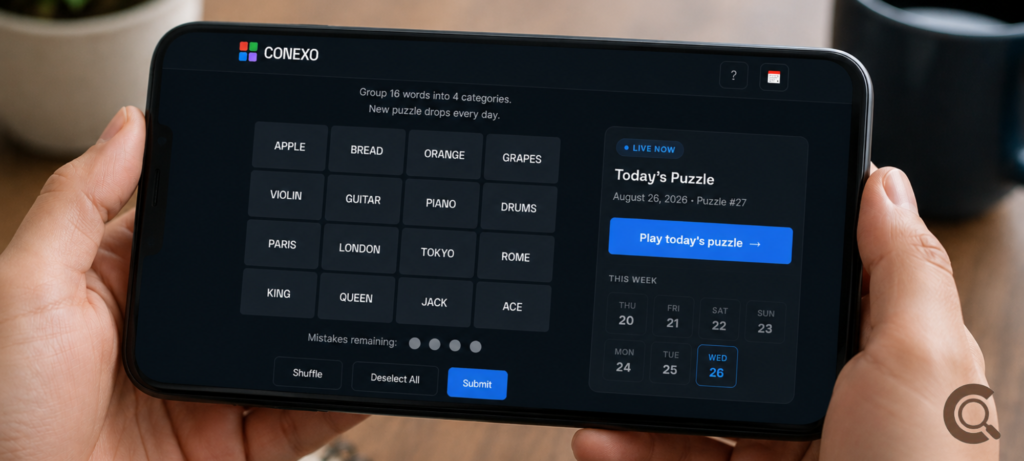
The Conexo word game has been picking up steady daily search interest, and once you actually sit down and play it, it’s easy to see why. Unlike letter-guessing puzzles, Conexo hands you 16 words and asks you to sort them into four hidden groups of four, each sharing a secret theme you have to figure out yourself. It’s less about spelling and more about spotting patterns — a genuinely different kind of mental workout than something like Wordle, and one that rewards a slower, more careful kind of thinking.
Quick answer: Conexo is a daily word puzzle where players group 16 words into four sets of four based on a shared hidden theme, similar in spirit to the New York Times’ Connections but with its own puzzle style and difficulty curve.
What Is the Conexo Word Game?
Conexo presents a 4×4 grid of 16 words. Your job is to figure out which four words belong together based on some connecting idea — that could be a straightforward category, a wordplay trick, or a looser theme that only clicks once you’ve spotted the first couple of matches. Selecting four words you believe belong together locks them in as a guess, and the game tells you right away whether you’ve got it or not.
The tricky part, and honestly the fun part, is that words are deliberately chosen to look like they could fit into more than one group. A word that seems obviously “animals” might actually belong to a wordplay-based group instead — that kind of misdirection is exactly what makes the puzzle satisfying once you finally crack it, rather than feeling like a simple sorting exercise.
This format sits in a growing category of puzzles built around categorization rather than spelling. Where Wordle asks you to deduce letters and Contexto asks you to guess based on meaning, Conexo asks you to spot hidden relationships across a whole board at once — a skill that leans more on pattern recognition than vocabulary size.
How to Play Conexo Step by Step
Getting started with Conexo is straightforward, even if solving it consistently takes a bit of practice.
- Scan all 16 words before touching anything. Reading through the full board first often reveals an obvious group before you’ve even started actively solving, and it gives you a mental map of what you’re working with.
- Look for the most specific category first, not the broadest one. Specific themes — brand names, a particular word pattern, a niche category — tend to have far fewer plausible candidates than something vague like “things that are round.” Specific categories narrow down faster and give you a foothold.
- Watch for decoys. Conexo intentionally places words that seem to belong to an easy category but actually fit a trickier one elsewhere on the board. If a group feels too obvious right away, it’s worth double-checking the other twelve words before locking anything in.
- Save your least confident group for last. By the time you’ve correctly placed three groups, the fourth is often just whatever’s left over — frequently the easiest “solve” in the entire puzzle, even if it looked confusing at first glance.
- Use process of elimination actively, not passively. If a word doesn’t cleanly fit any theme you’ve already spotted, it almost certainly belongs to the group you haven’t figured out yet. Treat leftover words as clues in themselves.
Conexo Tips to Solve Faster
A handful of habits separate players who solve consistently from those who get stuck guessing at random. Reading the whole board before touching anything is the single biggest one — jumping straight into the first pattern you notice is how most wrong guesses happen, and wrong guesses can cost you either lives or time depending on the mode you’re playing.
Thinking in terms of wordplay, not just dictionary categories, also matters a lot here. Puzzles in this genre frequently hide answers behind puns, homophones, or compound-word tricks rather than straightforward groupings, so training yourself to consider “does this word sound like something else” alongside “what category is this” opens up solves that a purely literal read would miss entirely.
It’s also worth resisting the urge to lock in a guess the moment you spot four words that seem to fit together. Pausing for a few extra seconds to double-check whether any of those four might actually belong somewhere else saves more wrong guesses than almost any other single habit. A lot of near-misses in this genre come from confidently locking in a guess two seconds too early.
Finally, don’t be afraid to work on the hardest-seeming group in the middle of solving rather than saving it for last automatically. Sometimes tackling the trickiest theme early, while you still have the full board of information to compare against, makes it easier to spot than trying to reverse-engineer it from three leftover words at the very end.
Conexo vs Similar Word Games
If you’ve played the New York Times’ Connections puzzle, Conexo will feel immediately familiar — both use the same core structure of grouping 16 words into four hidden sets. The difference tends to show up in theme style and difficulty curve, with Conexo leaning slightly more toward wordplay-heavy groupings in some of its daily puzzles, and offering its own take on scoring and progression that differs from the original format.
Games in this category have grown quickly over the past couple of years, largely because the “group by hidden theme” mechanic scales well across languages and cultures — a puzzle built around categories translates more naturally than one built around English letter patterns, which partly explains why Conexo and similar titles have found strong audiences well beyond English-speaking players.
Where to Play Conexo
Conexo is free to play, and you can try today’s puzzle directly at conexo.uk. The site updates with a new puzzle daily, so there’s always a fresh challenge waiting rather than a static set of levels to work through once and abandon.
Frequently Asked Questions
What is the Conexo word game?
Conexo is a daily word puzzle where players sort 16 words into four hidden groups of four, based on a shared theme. It’s similar to NYT Connections and focuses on pattern recognition rather than spelling or letter guessing.
Is Conexo the same as NYT Connections?
They share the same core format — grouping 16 words into four sets of four — but Conexo has its own puzzle style, theme choices, and progression. Fans of one tend to enjoy the other, since both reward the same style of thinking.
How do I get better at Conexo?
Read all 16 words before making any guesses, look for the most specific category first, and stay alert for decoy words that seem to fit an obvious group but actually belong to a trickier one. Saving your least confident group for last, and pausing before locking in a guess, both help reduce wrong answers.
Is Conexo free to play?
Yes. Conexo is free to play, with a new puzzle released daily.
Where can I find today’s Conexo puzzle?
The daily puzzle is available at conexo. Checking the site directly each day is the most reliable way to get the current puzzle without relying on third-party hint pages that may lag behind the actual daily release.
Why do these grouping puzzles feel harder than letter-based games?
Grouping puzzles ask you to hold all 16 words in mind at once and consider multiple possible categories simultaneously, rather than narrowing down letter by letter. That wider mental load, combined with intentional decoys, is what makes this genre feel more demanding even though there’s no time pressure or limited attempts in most versions.
Final Thought
The Conexo word game rewards a different kind of thinking than most daily puzzles — less about vocabulary size and more about spotting patterns, resisting the obvious first guess, and holding several possible categories in mind at once. Once the core strategy clicks — scan everything first, hunt for the specific category, and watch for decoys — most puzzles get noticeably faster to solve, and the satisfaction of catching a well-hidden wordplay group tends to be what keeps players coming back day after day.
You may also like => Contexto