
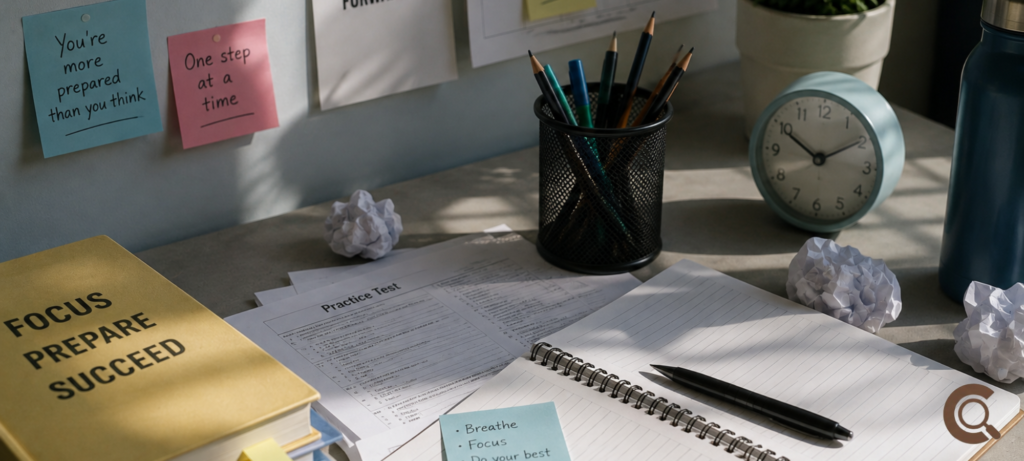
Here’s something worth knowing if you’ve ever gone completely blank halfway through an exam on material you knew cold the night before: test anxiety is a lot more common, and a lot more physical, than most people assume. A 2026 meta-analysis pulling together 67 studies and over 43,000 students found that nearly half of all students, 48.43% of them, deal with some level of exam anxiety, and roughly one in five experience it badly enough to actually disrupt their performance. This isn’t some rare thing that only hits the especially nervous kid in the front row. It’s closer to normal than most classrooms ever let on.
What Test Anxiety Actually Does to Your Brain During an Exam
The freezing itself isn’t just “being nervous,” even though that’s how it usually gets dismissed. What’s actually happening is that anxiety eats into your working memory, the small mental workspace your brain uses to juggle information in the moment, whether you’re solving an equation or trying to recall a date for a history question. Psychologists call this the interference hypothesis: anxious thoughts, worrying about failing, comparing yourself to the kid next to you, running through worst-case scenarios, are all fighting for the exact same limited mental space you need for the question in front of you. The more of that space gets swallowed by worry, the less you have left to actually think.
EEG studies looking at brain activity during working memory tasks back this up. Students with high test anxiety show noticeably less engagement in the attentional control networks that low-anxiety students seem to switch on automatically under the same load. Put simply, the anxious brain is running on less working memory in the exact moment it needs the most of it.
It’s Not Just “In Your Head.” There’s a Real Physical Side Too
On top of the mental interference, there’s an actual physical stress response happening at the same time. A high-stakes, timed test can trigger the same fight-or-flight response your body reserves for real physical danger: cortisol spikes, your heart rate climbs, that unmistakable stomach-drop feeling right before the paper hits your desk. In small doses, none of this is a bad thing. A little activation can genuinely sharpen your focus. The trouble starts when it overshoots, and now the physical symptoms themselves, the racing thoughts, the shallow breathing, the sudden blank, are competing for your attention right alongside the actual test.
The Research Isn’t as One-Sided as You’d Expect
It’s worth being upfront about something most articles on this topic conveniently skip. While the interference idea is well supported, at least one notable study on German medical students found that test anxiety didn’t actually predict how well students did once you controlled for how much they’d actually studied. That’s a real wrinkle. It suggests that for some students, what looks like “anxiety wrecking a good performance” might really just be undercooked preparation causing both the anxiety and the weak score, rather than anxiety being the whole story on its own.
Practically speaking, that means preparation is doing more of the heavy lifting here than people usually give it credit for, which is exactly why pairing study habits with anxiety management tends to beat treating either one alone. Building a study routine that cuts down on last-minute uncertainty is one of the more effective ways to lower exam-day anxiety before it even starts. Our guide on preparing for competitive exams from home walks through how spaced, structured prep removes a lot of the uncertainty fueling anxiety in the first place, rather than just treating the symptoms on the day itself.
What Actually Helps, According to the Research
A handful of specific things have real evidence behind them, well beyond the usual “just relax” advice everyone’s already heard a hundred times.
Cognitive reappraisal is one of them. It just means consciously reframing the physical sensation, your racing heart, as excitement or readiness instead of fear. It sounds almost too simple to work, but the framing genuinely changes how your brain interprets the exact same physical signal.
Mindfulness practice helps too, and recent research points to two separate reasons why: it improves cognitive reappraisal directly, and it builds general psychological resilience that cushions against anxiety before it even shows up. This isn’t about sitting cross-legged for an hour before an exam. Even brief, regular practice in the weeks leading up to a test shows measurable effects.
Pairing relaxation techniques with actual study-skills training beats either one used alone, too. Older research on combining relaxation therapy with study-skills coaching found meaningfully better results than relaxation by itself, which lines up with the same point from the German medical student study: preparation and anxiety management genuinely work better together than as substitutes for each other.
Retrieval practice, testing yourself on the material instead of just rereading it, pulls double duty here. It’s already one of the best-supported study techniques for actually retaining information, and it reduces test anxiety on the side by making the pressure and format of a real exam feel familiar rather than brand new when the day actually arrives.
Recognizing Test Anxiety When It’s Actually Happening
Before getting into what to do about it, it helps to actually name what test anxiety looks like, since a lot of students go through it without ever labeling it correctly. Physically, that’s a racing heart, shallow or held breath, sweaty palms, nausea, or a sudden headache right as the test starts. Mentally, it’s your mind going unexpectedly blank on something you knew an hour ago, thoughts looping about failing, and rereading the same question three or four times without actually absorbing it. Once you can recognize these signs as they’re happening, rather than just feeling generally awful and pushing through, you’re in a much better position to actually do something about them.
What to Actually Do the Moment You Freeze
This is the part most explanations skip entirely, and it’s honestly the one people searching this topic actually want answered.
Writing your worries down first is a surprisingly well-studied option. A well-known 2011 study published in Science by Ramirez and Beilock had anxious students spend ten minutes before an exam just writing about their fears, and it nearly closed the performance gap between high- and low-anxiety students. The highly anxious students who wrote beforehand scored close to a full letter grade higher than those who didn’t. To be fair, a later 2021 attempt to replicate this across four real college exams didn’t get the same result, so it’s not a guaranteed fix for everyone in every classroom. Still, it costs nothing and takes ten minutes, so it’s a pretty low-risk thing to try if you’ve got any time before the test starts.
A short physical reset genuinely helps too. Something as simple as a slow four-count inhale, a four-count hold, and a four-count exhale activates your parasympathetic nervous system and can measurably calm the physical arousal driving the freeze, even mid-exam. You don’t need silence or a quiet room for this. Thirty seconds at your desk before you pick your pencil back up is enough to make a difference.
If you blank on a specific question, skip it and come back later instead of staring it down. Answering something you actually know resets your working memory, and the momentum from getting a few right often unlocks the thing you were stuck on when you circle back to it.
And sometimes just naming what’s happening helps more than people expect. Quietly telling yourself “this is test anxiety, not proof I don’t know the material” interrupts the spiral of catastrophic thinking that tends to make the freeze worse. It sounds almost too small to matter, but separating “I feel anxious” from “I am failing” is exactly the kind of reappraisal the earlier research is built on.
When Test Anxiety Might Be Something to Talk to Someone About
For most students, the strategies above genuinely cut down the disruption. But if test anxiety is consistently bad enough to seriously hurt your grades, causes real physical symptoms like nausea or panic, or makes you dread school in general, that’s worth bringing up with a school counselor or a mental health professional rather than just white-knuckling through it alone. Understanding how memory and anxiety interact also helps make sense of all this. Our breakdown of how memory actually works during learning explains why anxious working-memory overload and simply not having learned the material well enough can look almost identical from the outside, even though the fixes for each are a little different.
Frequently Asked Questions
Why do I freeze up specifically during timed tests but not regular quizzes?
Time pressure ramps up the competition between anxious thoughts and the actual test content, and test anxiety tends to scale with how much is riding on the result. A heavily weighted, strictly timed exam sets off a much stronger response than a casual quiz, even when you know the material equally well in both cases.
What are the actual symptoms of test anxiety?
Physically, think racing heart, sweaty palms, nausea, shallow breathing. Mentally, it’s your mind suddenly going blank on stuff you know, racing thoughts about failing, and struggling to process questions that would normally be easy for you.
Can test anxiety actually make you fail even if you know the material?
It can drag your score down by eating into the working memory you need during the test, though the research is genuinely mixed on how much of that is pure anxiety versus gaps in preparation underneath it. It’s rarely the entire reason someone fails outright, but it can absolutely pull down a score that should’ve reflected what they actually knew.
Is there anything I can do right before or during the test, not just weeks in advance?
Yes, actually. A quick expressive-writing exercise about your worries, slow paced breathing, skipping a frozen question instead of staring at it, and briefly naming the anxious feeling instead of reacting to it all have real research behind them, even if results vary a bit from person to person.
How common is test anxiety, really?
More common than most people think. A 2026 meta-analysis of over 43,000 students found close to half experienced some level of exam anxiety, with about one in five hitting a level that genuinely disrupted their performance.
Final Thoughts
Test anxiety is common enough that it’s really just a normal part of being a student for close to half of all students, not some personal flaw or proof you’re not cut out for high-pressure testing. The research shows a real, mechanical interference with working memory rather than plain nervousness, but it also shows that solid preparation paired with a few specific, evidence-backed strategies, cognitive reappraisal, mindfulness, retrieval-based studying, genuinely loosens its grip. Treating preparation and anxiety management as one combined approach rather than picking a side is what the evidence keeps pointing back to.