
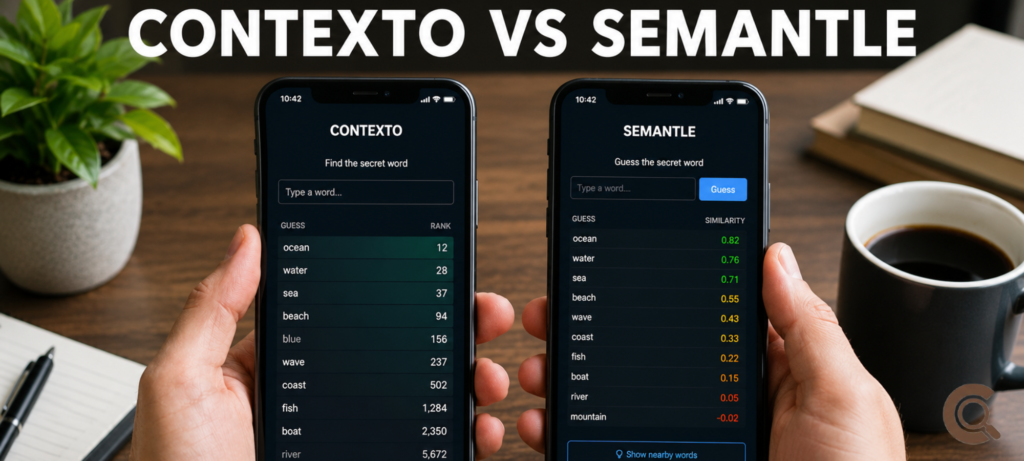
If you’ve spent any time in the word-game corner of the internet lately, you’ve probably run into both of these. Contexto vs Semantle is one of those comparisons that keeps popping up in gaming forums and Reddit threads, and for good reason — both games ditch the letter-guessing format that Wordle made famous and replace it with something trickier: meaning. Instead of figuring out which letters go where, you’re trying to land on a hidden word based on how closely it relates to your guesses. It sounds simple until you actually sit down and play for twenty minutes without moving past rank 800.
Semantic word games have quietly become one of the more addictive corners of daily puzzle culture, and Contexto and Semantle are the two names that keep coming up as the originators of the format. Both use AI to measure how “close” your guess is to the answer, but the way they present that closeness — and how brutal they are about it — is where the real differences start to show.
What Are Contexto and Semantle?
Before comparing difficulty, it helps to understand what each game is actually doing under the hood, because they’re not twins — they’re more like cousins who grew up in different houses.
How Contexto Works
Contexto gives you a text box and nothing else. You type a word, hit enter, and the game returns a number — your rank. Rank 1 is the answer. Rank 2 might be a close synonym or a word that shows up in similar contexts. Rank 4,000 might be something wildly unrelated, and the game won’t tell you why.
What makes Contexto interesting is that it doesn’t reward you for guessing synonyms in the traditional dictionary sense. It rewards you for guessing words that appear in similar contexts online — which is a subtly different thing. You could guess “ocean” and get rank 12, then guess “sea,” a near-synonym, and land at rank 900. That disconnect between what feels logical and what the algorithm actually rewards is where most of the frustration — and honestly, most of the fun — comes from.
How Semantle Works
Semantle works on a similar foundation but presents it differently. Instead of a plain rank number, you get a similarity score, usually somewhere between -100 and 100, based on cosine similarity between word vectors. A score in the 40s or 50s means you’re in the right neighborhood. A score near 90 means you’re circling the answer. Anything below 10 and you’re basically guessing in the dark.
Semantle also gives you a “nearby word” hint system if you’re stuck for too long, which Contexto notably does not offer in its base version. That single design choice changes how each game feels to play — Semantle occasionally throws you a rope, while Contexto mostly lets you drown.
Contexto vs Semantle: Key Differences
Here’s a side-by-side breakdown that sums up where the two games actually diverge:
| Feature | Contexto | Semantle |
|---|---|---|
| Feedback style | Numeric rank (1, 2, 3…) | Similarity score (-100 to 100) |
| Difficulty | Moderate, curve softens with practice | Steeper, especially for abstract answers |
| AI technology | Word co-occurrence / embedding-based ranking | Word2Vec-style embeddings, cosine similarity |
| Hint system | Minimal (some versions offer none) | Built-in “nearby words” hint |
| Learning curve | Gentler once you learn the logic | Takes longer to build intuition |
| Daily challenge | One puzzle per day, unlimited guesses | One puzzle per day, unlimited guesses |
Both games reset daily and both let you guess as many times as you want, so neither punishes you for taking your time — the punishment is purely psychological.
How Semantle’s Word Embeddings Work
This is the part that trips people up, so let’s keep it simple. Semantle relies on word embeddings, which are essentially a way of turning words into lists of numbers (vectors) based on how they’re used across huge amounts of text. Words that show up in similar sentences end up with similar-looking vectors, sitting closer together in what’s called vector space.
To measure how close two words are, Semantle calculates cosine similarity — basically the angle between two word vectors rather than the straight-line distance between them. A smaller angle means a higher similarity score. This is standard practice in natural language processing, and it’s the same underlying idea that powers a lot of modern search engines and recommendation systems, just applied here to a daily guessing game instead of something more commercial.
The tricky part for players is that this kind of semantic similarity doesn’t always match human intuition. “King” and “queen” will score high, sure. But “king” and “chess piece” might score higher than you’d expect too, because of how often those words appear together in training text — even though they’re not synonyms in any traditional sense.
Contexto Ranking System Explained
Contexto’s ranking system works on a related but distinct idea. Rather than giving you a raw similarity score, it pre-computes the similarity of every word in its dictionary to the answer and then sorts them into a ranked list. When you guess, you’re just being told where your word landed on that list.
This creates a slightly different play pattern than Semantle. Because you can’t see the actual similarity number, only your position relative to every other word, Contexto rewards a kind of lateral thinking — guessing categories, related concepts, and word clusters rather than trying to inch a percentage score upward. Experienced players often build a mental map: guess a broad category word first, see where it lands, then branch out toward related ideas based on that rank.
Which Game Has a Bigger Learning Curve?
Honestly? Semantle wins this one, and it’s not close.
Beginners tend to bounce off Semantle within the first few days because a similarity score of “12” doesn’t feel like progress the way climbing from rank 4,000 to rank 200 in Contexto does. There’s something psychologically satisfying about watching a number drop toward 1, even slowly. Semantle’s score can plateau in the 30s for what feels like forever, and that plateau is where a lot of casual players give up.
Advanced players in both games develop similar strategies — starting broad, testing category words, then narrowing based on feedback. But Semantle demands more patience before that strategy starts paying off visibly. Contexto, by contrast, gives you enough small wins early on (moving from rank 10,000 to rank 500 feels huge) to keep you hooked even when you’re nowhere near the answer.
Time-to-solve is also worth mentioning. On an average day, Contexto tends to get solved faster by most players, partly because the ranking feedback is easier to interpret at a glance. Semantle’s puzzles, especially when the answer is an abstract noun or a word with multiple unrelated meanings, can drag on for well over an hour.
Contexto vs Semantle: Which One Is Better?
There isn’t a single right answer here — it really depends on what kind of player you are.
- Casual players will probably enjoy Contexto more. It’s quicker to understand, the feedback loop is more forgiving, and you can walk away mid-puzzle without losing your train of thought.
- Vocabulary lovers might lean toward Semantle, since the raw similarity scores expose more of the underlying language relationships and reward a wider working vocabulary.
- Puzzle enthusiasts who like a slow burn and don’t mind sitting with a problem for a while will probably prefer Semantle’s tougher curve.
- AI and technology fans will likely appreciate Semantle a bit more too, simply because the mechanics — word embeddings, cosine similarity — are more visible in how the game presents feedback.
If you’re new to semantic word games as a category, start with Contexto. It’s the friendlier on-ramp. Once you’ve got a feel for how these AI word game systems “think,” Semantle will make a lot more sense, and you’ll enjoy the extra depth instead of finding it frustrating.
Contexto and Semantle Alternatives
If you’ve cleared both of these and want more of the same daily-puzzle-streak feeling, there are a few solid options worth trying. Wordle is the obvious starting point for anyone who wants letter-based logic instead of semantic guessing. NYT Connections offers a different kind of pattern-recognition challenge, grouping words by hidden categories rather than similarity scores. Heardle applies the same daily-guess format to music instead of language, which is a nice change of pace if you need a break from words altogether.
There’s also a growing list of smaller word games like Contexto that use similar embedding-based mechanics, though most haven’t reached the same level of daily traffic or community following as the two covered here.
Frequently Asked Questions
Is Contexto harder than Semantle?
No — generally Semantle is considered the harder of the two. Contexto’s ranking feedback is easier for most players to interpret quickly, while Semantle’s raw similarity scores take longer to build intuition around, especially for abstract or multi-meaning answer words.
What is the difference between Contexto and Semantle?
The main contexto and semantle difference comes down to feedback format. Contexto shows a numeric rank compared to every word in its dictionary, while Semantle shows a similarity score based on cosine similarity between word embeddings. Semantle also includes a hint system that Contexto largely lacks.
Are Contexto and Semantle AI-based games?
Yes. Both rely on natural language processing techniques, specifically word embeddings, to measure how closely related two words are in meaning. This is the same underlying technology used in many modern search and recommendation systems.
Which semantic word game is best?
It depends on preference. For a gentler introduction to semantic word games comparison, Contexto is usually recommended first. Players looking for a deeper challenge and more transparent scoring tend to prefer Semantle once they’ve built up some experience.
Are there games like Contexto?
Yes — Semantle is the most direct comparison, but Wordle, NYT Connections, and Heardle all scratch a similar daily-puzzle itch, even though their mechanics differ. If you’re searching for a semantle alternative or a contexto alternative, all three are worth trying.
Conclusion
At the end of the day, the contexto vs semantle debate doesn’t really have a loser — it has two games built around the same clever idea, executed with different levels of forgiveness. Contexto is the better starting point for most people, with feedback that’s easy to read and small wins that keep you playing. Semantle asks more of you, but it pays that patience back with a puzzle that feels genuinely earned once you crack it. Try both for a week and you’ll probably land on a favorite — mine changes depending on how much patience I have that day, and that’s honestly part of the fun.