
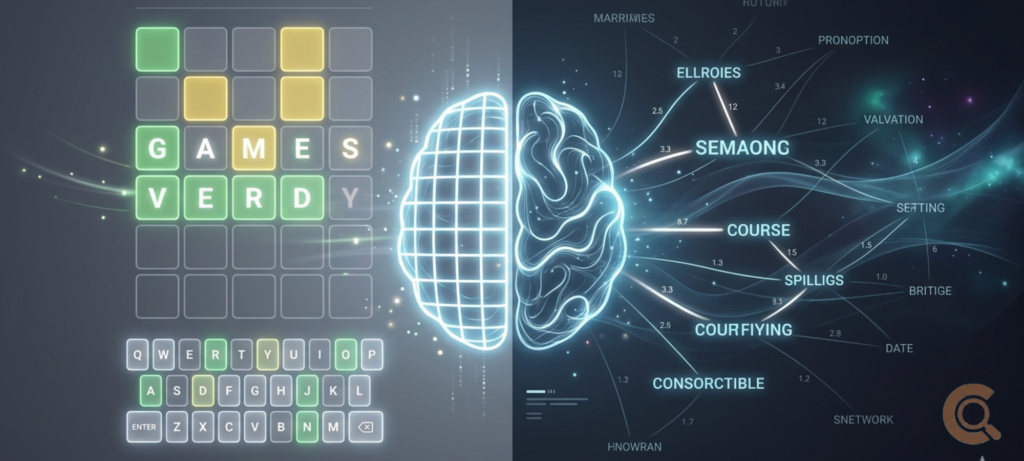
The great word game debate of the past few years has been simple: Wordle or something else? Since the New York Times acquired Wordle in 2022 and made it the centrepiece of its games section, every new word game has been measured against it. Contexto is one of the few games that has genuinely earned a spot in that conversation — and for players who have tried both, the question of which one is harder comes up constantly.
The honest answer is that they are hard in completely different ways. Wordle tests one type of linguistic intelligence. Contexto tests another. Understanding the difference is actually the key to getting better at both.
The Core Difference in How They Work
Wordle gives you a five-letter word to guess in six tries. After each guess, the game tells you which letters appear in the answer and whether each letter is in the correct position. The puzzle is essentially a constrained letter-search problem. You are narrowing down possibilities based on which letters the answer contains.
Contexto gives you a word to find with unlimited guesses. After each guess, the game tells you how semantically similar your word is to the answer — not whether it shares any letters. The puzzle is a meaning-search problem. You are navigating conceptual space rather than alphabetical space.
That distinction sounds simple but it means the two games require fundamentally different skills. Wordle rewards pattern recognition, logical elimination, and knowledge of common letter combinations in English. Contexto rewards vocabulary depth, conceptual flexibility, and the ability to think in relationships and categories rather than sequences.
Where Wordle Is Harder
Wordle has a hard constraint that Contexto does not: you only get six guesses. That creates genuine pressure. One careless guess can box you into an impossible position where multiple valid answers remain but you only have one or two tries left. Advanced players who play on hard mode — where confirmed letters must be used in every subsequent guess — know exactly how brutal this constraint can be.
The letter-knowledge element of Wordle also has a depth to it that beginners underestimate. Knowing that certain letter combinations almost never appear in English five-letter words, understanding which vowel patterns are common, and having a bank of strong starting words like CRANE, SLATE, or AUDIO takes real practice to develop.
Wordle also has a clean finish. You either get it in six or you do not. There is a binary clarity to the outcome that Contexto does not share.
Where Contexto Is Harder
Contexto does not have a guess limit, but do not let that fool you into thinking it is easier. Many players take well over fifty guesses on difficult days. The lack of a ceiling means you can spend ten minutes circling the right semantic cluster without ever quite landing.
The deeper challenge in Contexto is that you cannot directly observe what you are measuring. In Wordle, the feedback is concrete — this letter is in the word, that letter is not, this letter is in the wrong position. In Contexto, the feedback is a number representing an abstract semantic distance. Interpreting that number requires genuine vocabulary knowledge and the ability to think about how words relate to each other across multiple dimensions simultaneously.
A rank of 150 on the word “shore” could mean the answer is “beach,” “coast,” “cliff,” “tide,” or “harbour” — or something less obvious like “summer” or “holiday.” The number tells you that you are close, but not in which direction. That interpretive challenge is genuinely difficult and it never fully goes away, even after months of practice.
There is also the issue of abstract answers. Wordle answers are always common five-letter words. Contexto answers can be abstract concepts — justice, freedom, pressure, growth — where the semantic cluster is broad and diffuse and it is very hard to know when you are getting warmer versus when you are just circling a related cluster that happens to sit nearby.
Skill Ceiling and Long-Term Development
This is where the two games diverge most significantly. Wordle has a relatively low skill ceiling. Once you have learned the optimal starting words and understand the basic strategy of eliminating letters systematically, improvement slows dramatically. You will still lose occasionally due to unlucky letter distributions or unusual answer choices, but the game does not offer a deep strategic rabbit hole to go down.
Contexto has a much higher skill ceiling. The players who are genuinely exceptional at Contexto have developed something that resembles an instinct for semantic space — they can sense which conceptual neighbourhood a word lives in and pivot rapidly when a cluster runs cold. That skill takes a long time to build and it transfers to real-world language ability in ways that Wordle’s letter-pattern skills simply do not.
Research on vocabulary acquisition from Oxford Learner’s Dictionaries consistently shows that learning words in semantic groups — alongside related words and in context — is far more effective than learning them in isolation. Contexto effectively forces you to think about words in exactly that way, every single day.
Which Game Is Better for Your Brain?
Both games offer cognitive benefits, but they target different abilities. Wordle is excellent for working memory, pattern recognition, and logical deduction under pressure. It is the verbal equivalent of a logic puzzle. Contexto is better for semantic memory, conceptual flexibility, and the kind of associative thinking that underlies creative problem-solving and strong communication.
If you want to sharpen your general reasoning and pattern recognition, Wordle is efficient. If you want to genuinely expand and deepen your vocabulary and your feel for how language works conceptually, Contexto is the stronger choice.
The best argument, of course, is to play both. They take a combined total of roughly ten minutes per day and the skills they develop are complementary rather than overlapping.
Community and Social Dimension
Wordle has a massive cultural footprint partly because its result-sharing feature — those little coloured emoji grids — was perfectly designed for social media. Players could share their result without spoiling the answer for others, which created a genuinely viral sharing mechanic.
Contexto’s sharing mechanic is less immediately viral but arguably more interesting to read. Sharing your guess count and the path you took through the semantic space tells a much more interesting story than a grid of coloured squares. A Contexto result that says “solved in 34 guesses” with a trail of near-misses around the right cluster is genuinely compelling to anyone who plays the game.
The Contexto community tends to be slightly more dedicated than casual Wordle players simply because the game requires more investment. Players who stick with Contexto past the first week tend to stay with it for months or years.
The Verdict
Contexto is harder in the ways that matter most for genuine intellectual challenge. The unlimited guess format is not a concession to difficulty — it is a necessity, because the problem the game poses is fundamentally more complex than Wordle’s. You are not just looking for a specific five-letter sequence. You are navigating an invisible map of meaning using only distance readings as your guide.
Wordle is hard in a tighter, more immediately frustrating way. The six-guess limit creates real stakes and the occasional day where you walk right into a letter trap and lose outright is genuinely annoying.
If you are brand new to Contexto and want to build your skills methodically, our guide on Best Starting Words for Contexto is the best place to begin. And if you want to see how today’s puzzle unfolds with a bit of guidance, our daily answer and hints page is updated every morning.
Either way, both games deserve a place in your daily routine. Your brain will thank you for it.


Pingback: Contexto vs Dordle: Which Daily Word Game Should You Play?