
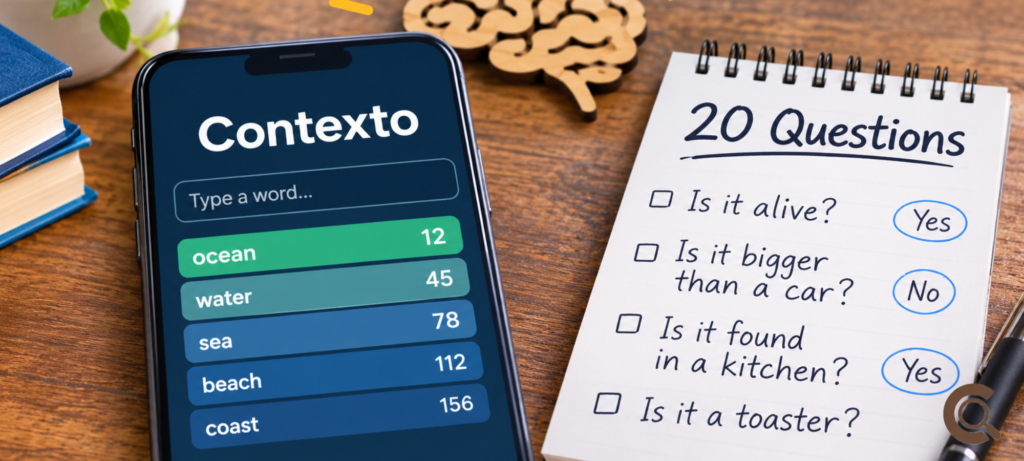
Contexto and 20 Questions start from the same place: there is a secret word, and you have to find it. After that, they could hardly be more different. Contexto lets you guess any word you like and tells you how close you got. 20 Questions lets you ask anything you like, but it answers only “yes” or “no.”
If you play Contexto every day, a yes-or-no guessing game is worth trying, and not only because it’s a change of pace. The two games train opposite muscles, and getting better at one makes you better at the other. Here’s how they compare and what carries over.
How Each Game Works
Contexto
You type a word and get its rank: the secret word is number 1, and every other word is ranked by how close it is in meaning, as measured by an AI model trained on large amounts of text. A guess ranked 50 is “near” the answer, while one ranked 4,000 is not. You can make as many guesses as you need, and the puzzle resets every day.
20 Questions
One side holds a secret, and you ask questions that can be answered with yes or no: “Is it alive?” “Is it bigger than a car?” “Would you find it in the kitchen?” A direct guess (“Is it a toaster?”) counts as one of your questions, and you have twenty in all. There’s no ranking and no “warmer or colder,” only a series of yes and no answers that you have to put together yourself.
Side by Side
| Contexto | 20 Questions | |
| What you send | A guess (a single word) | A question in your own words |
| What you get back | A rank showing how close in meaning | Yes or no |
| Limit | None; you can keep guessing | 20 questions, guesses included |
| Main skill | Vocabulary and association | Logic and narrowing down |
| Typical frustration | Stuck in the 200s with no idea which way to go | Burning questions on guesses too early |
| Best played | Alone, once a day | Alone or with friends, any time |
The Information Behind Each Answer
Here’s a useful way to think about it. A single yes-or-no answer can tell you at most one “bit” of information. It can, at best, cut the remaining possibilities in half. That sounds tiny, but twenty perfect halvings can pick out one word from more than a million (220 = 1,048,576).
A Contexto rank carries much more information per guess. It places your word somewhere on a scale of thousands. But the information is fuzzy. Words can rank close to the answer for reasons that have nothing to do with what the answer actually is. “Bread” might sit near “butter” because the two show up together, not because butter is a kind of bread. Experienced Contexto players learn to read that fuzziness. 20 Questions gives you less with each answer, but every answer is exact. When the answer is yes, you know it’s true.
That’s the core difference. Contexto rewards wide, associative thinking: “What words live near this one?” 20 Questions rewards strict, logical thinking: “What single question splits everything that’s left in half?”
What Context Players Get Wrong in 20 Questions
- Guessing too early. In Contexto, guesses are free. In 20 Questions, every guess costs a question. Hold your guesses until you’re down to two or three candidates.
- Asking “Is it related to…?” “Is it related to the ocean?” isn’t a yes-or-no fact; almost anything can be related to the ocean. Ask something that has a clear true answer: “Does it live in the ocean?”
- Testing neighbors. A Contexto habit is to try words near your best guess. In 20 Questions that means checking “Is it a dolphin?”, then “Is it a porpoise?”, then “Is it a whale?”, one at a time. Ask “Is it a mammal?” instead and settle all three at once.
What Carries Over from 20 Questions to Contexto
The trade works the other way too. Players who spend time with yes-or-no games tend to get better at Contexto in a few specific ways:
- They think in categories. When a Contexto game stalls, the best move is often to step up a level and guess the category instead of another specific word: “animal,” “tool,” “weather,” “emotion.” That’s exactly how a 20 Questions player opens a round.
- They test hypotheses on purpose. Instead of throwing words at the wall, they ask, “If the answer is something you eat, then ‘food’ should rank well. Does it?” That turns each guess into a real question.
- They keep a running summary. 20 Questions trains you to say what you know: “It’s alive, it lives in water, it isn’t a fish.” In Contexto, writing down your top three guesses and what they share does the same job.
Where to Play a Yes-or-No Word Game
The classic way is with other people. One person thinks of a word, and the group asks questions around the table or in the car. On your own, you need a computer to keep the secret. Akinator is the best-known guessing game online, but it reverses the roles: it asks the questions and tries to read your mind.
If you want the Contexto feeling of a daily puzzle with the 20 Questions rules, Couscous has a riddle of the day and a daily secret word. You type questions in plain language, and a little cartoon couscous answers only yes, no or “I don’t know” until you name the word. There are also themed rounds, such as animals, food, countries and space, if one puzzle a day isn’t enough.
Tips for Your First Yes-or-No Round
- Open with “Is it alive?” Almost any word list splits cleanly on it.
- Follow with “Is it made by people?” or “Can you hold it in your hand?”
- Ask about size against a familiar object: “Is it bigger than a chair?”
- Ask about the place: “Is it found in a house?” “Is it found outdoors?”
- Recap after every five questions and pick the question that cuts what’s left in half.
- Only guess when you could list every remaining candidate on one hand.
FAQ
Is 20 Questions harder than Contexto?
It’s different rather than harder. Contexto can drag on when you’re stuck far from the answer, while 20 Questions puts real pressure on you because the questions run out. Most players find Contexto harder to start and 20 Questions harder to finish.
Can AI answer yes-or-no questions reliably?
Modern language models are good at it for everyday words, which is why online versions of the game have improved a lot in the last few years. Edge cases are still fun to argue about: is a tomato a fruit, or is a whale a fish?
Which should I play every day?
Both, if you have the time. Contexto stretches your vocabulary, and a yes-or-no game sharpens your logic. Together they make a five-minute morning routine that works your brain in two directions.