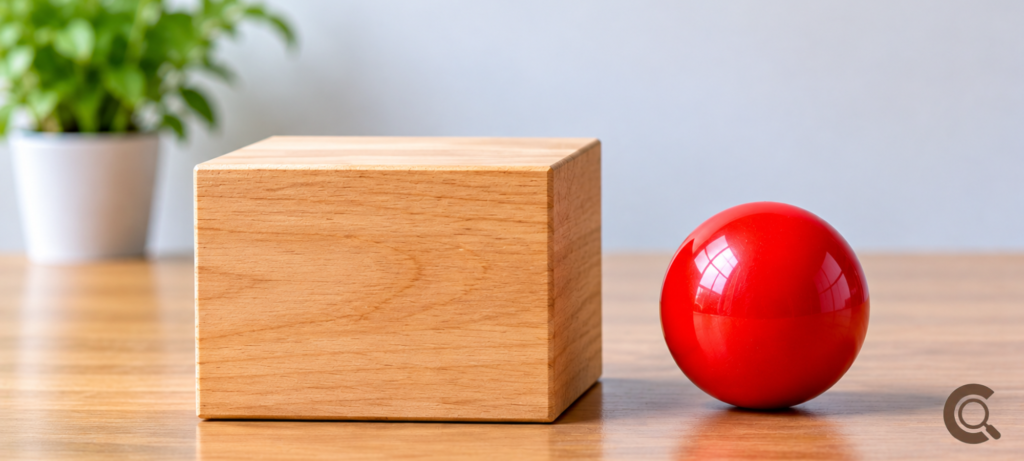
A red ball and a wooden box can make a surprisingly useful language exercise. Move the ball slightly, and the sentence changes: it is beside the box, behind the box, or beyond it. For a proposed visual vocabulary activity, I would build a short sequence around those relationships. The project would use familiar objects and carefully chosen camera positions, giving learners something concrete to describe before showing them any suggested words.
I would keep the activity separate from a test of vocabulary knowledge. There would be no score and no claim that watching the clip improves learning by a measured amount. My aim would be to create a prompt for conversation: what do you see, which word fits, and what would need to change for another word to become appropriate?
The distinction matters because an image rarely has only one possible description. A ball can be near a box and beside it at the same time. I would welcome that ambiguity where it creates a useful discussion, while making sure the scene is clear enough that learners are discussing language rather than struggling to identify the objects.
My reference kit would contain original photographs of one plain box and one red ball on a neutral tabletop. I would also sketch the intended camera view for each relationship. These materials would help me keep the objects consistent as their positions change. A short original movement reference could show how slowly I want the ball to roll into its final position.
Turning that plan into a visual draft brings Seedance 3.0 into the exercise. The AI video model supports text-to-video, image-to-video, and reference-based generation with combinations of text, images, video, and audio. I would use it to explore the scenes, then review each result against the intended spatial relationship before including it in an activity. This is a proposed workflow, not a completed classroom trial.
Choose a relationship the camera can show
I would begin with beside because it is easy to stage without hiding either object. The box would sit slightly left of center, and the ball would rest to its right with a visible gap. A front view would show both shapes clearly. I would avoid a steep overhead angle for the opening because it could make the box look like a flat rectangle.
For behind, I would move the ball farther from the camera and allow the box to hide part of it. The ball should remain identifiable, perhaps with its upper edge visible. If it disappears completely, the activity becomes a guessing game about an unseen object. I would choose a camera height that shows enough of the ball to make the relationship understandable.
Generate separate scenes for separate ideas
My first Seedance 3.0 brief would request only the beside scene, with a fixed camera and a gentle roll into position. I would not ask the ball to demonstrate several relationships in one uninterrupted move. Separate clips would let me pause, reorder, and compare the examples without requiring a complicated path that might become difficult to follow.
The written direction would describe the red ball, plain wooden box, neutral tabletop, and final gap between the objects. I would state that the box remains still and the camera does not move. The motion would stop before the clip ends so learners have time to inspect the final arrangement. That resting moment would be more important than an elaborate entrance.
Let learners speak before showing labels
I would show the first clip without text and ask for a short description. Only after discussion would I reveal a possible sentence in an ordinary editor: “The ball is beside the box.” Adding the lettering afterward would keep spelling, punctuation, and placement under direct control. It would also let me prepare a version without labels for a different group.
A Seedance 3.0 draft would therefore supply the visual situation, while the teaching decisions would remain separate. I would not assume that a convincing animation automatically becomes a good learning resource. The chosen words, the questions, and the amount of time available for discussion would still need thoughtful review by the person leading the activity.
Make ambiguity useful rather than accidental
For near and far, I would use two still endings with noticeably different distances between the same objects. I would explain that these words depend on context rather than a universal measurement visible in the picture. A ball across a small table may look far from the box within that scene, even though both objects are close to the viewer.
When reviewing Seedance 3.0 variations, I would check whether camera movement changes the apparent distance. A slow zoom could make the relationship feel different even when the objects stay in place. For this particular activity, I would prefer consistent framing. That gives learners a more stable basis for comparing the scenes and keeps the discussion focused on the intended words.
Inspect the objects before editing the sequence
For each Seedance 3.0 clip, I would compare the ball’s size, the box’s corners, and the tabletop across clips. If the ball grows between examples, learners may notice the size change before the spatial relationship. If the box opens unexpectedly, it introduces a new action and perhaps a new vocabulary topic. I would either revise those details or choose a simpler draft that keeps the objects recognizable.
Sound would remain optional. A quiet rolling sound might support the movement, but the exercise should work when muted. I would avoid spoken instructions inside the generated scene and add any narration separately if the activity calls for it. This would allow me to adjust the pace and wording without regenerating visuals that already communicate the relationships clearly.
End with a new sentence to consider
For the closing prompt, I would show the ball partly hidden by the box and ask which descriptions could all be true. Behind, near, and partly hidden might each capture something useful. The point would be to notice how language selects different features of the same scene. I would leave enough time for someone to explain why they chose a word rather than treating the first answer as the only answer.
This Seedance 3.0 project would succeed for me if the visuals invite careful observation and a little disagreement worth discussing. A red ball and a wooden box do not need spectacular effects to do that work. They need consistent shapes, readable positions, and a pause long enough for people to connect what they see with what they mean.