
On 21 June 2018, a company owned by the people of north-west Mull completed the purchase of the island of Ulva, a mile off Mull’s western shore, for four and a half million pounds. Ulva is about seven miles long. Its population at the time of the sale was six.
It had not always been six. In 1837 there were something like six hundred people on Ulva, in townships strung along its south coast, growing potatoes and gathering kelp. Within a generation almost all of them were gone, and the man who put them off the land was the island’s laird, a lawyer from Stirling named Francis William Clark. He shared his surname with the dark blue Clark tartan, a cloth with a gentler history than his.
That is the sad middle of the island’s story. The beginning and the end are better, and the name Clark runs through all of it.
The Island Before the Clarks
Ulva belonged for centuries to the Macquaries, a small clan who held it under the Lords of the Isles and later under the MacLeans of Duart. In October 1773 Dr Samuel Johnson and James Boswell, on their tour of the Hebrides, were rowed across to Ulva in the dark and put up for the night by the chief, Lachlan Macquarie, in a house Johnson found “mean” but whose hospitality he praised. Boswell, who noticed everything, recorded that the chief was in debt and would soon have to sell.
Eleven years before that visit a boy had been born on Ulva who would become the most famous Macquarie of all. Lachlan Macquarie, the chief’s kinsman, joined the army, served in America, India and Egypt, and in 1810 became Governor of New South Wales. He found a penal colony and left it, twelve years later, a country: with towns, roads, a bank, a currency, and a policy of treating freed convicts as citizens that made him enemies in London and a founding father in Sydney. He is buried on Mull, across the sound from the island where he was born, under a stone that calls him the Father of Australia.
And in 1792 a young man named Neil Livingstone left Ulva for the mainland, where his grandson David would be born in Blantyre, become a missionary, and walk across Africa.
The Laird Who Emptied It
Francis William Clark bought Ulva in 1835. He was a solicitor, not a chief, and the island was an investment. When the potato blight arrived in 1846 and the kelp trade had already collapsed, the tenants could not pay their rents, and Clark set about removing them. Roofs were pulled off. Families were put on the shore with their belongings. Some went to Glasgow, some to Canada, some to Australia, following Macquarie’s road. By the census of 1881 the island that had held six hundred people held around fifty. The ruined walls of the cleared townships are still there in the bracken on the south side.
The Clarks kept Ulva for a century and more. In the twentieth century they were, by the accounts of those who knew them, decent landlords, and one of them, a young officer of the Argylls, died at Gallipoli in 1915. But the island never recovered its people, and by 2018 the last laird, a descendant by marriage, had put it on the market. The community of Mull, with help from the Scottish Land Fund, bought it. There is a plan now, slow and careful, to bring people back: houses restored, the ferry kept running, the old farm and the woodland worked again by people who live on the ground rather than own it from a distance. It will take years. Islands do.
Three Colours, Five Names
The tartan those Clarks wore has one of the more tangled entries in the archives. The Clarks of Ulva had a sett of their own, azure and black with old red lines, recorded in a Wilsons of Bannockburn pattern book of 1847, and it was a kilt in that cloth, made for a Clark of Ulva around 1930 and worn to a light grey and a faded brown, that the family brought to the tartan authorities for identification in 2005.
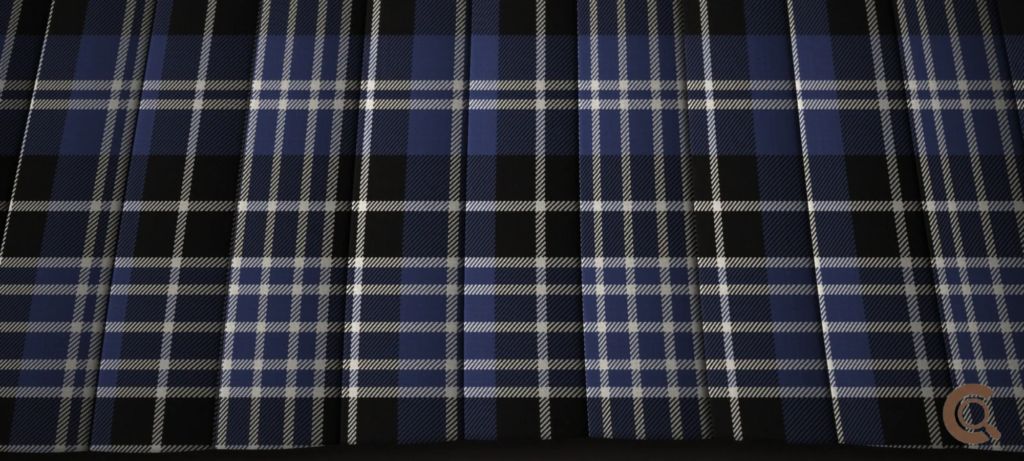
The tartan sold today as Clark is a different and simpler thing, and its story is in its names. The archives record that it appears, with slight variations, in the works of Logan, of the Smith brothers and of Wilsons, all dating from around 1850, and that it is “called Clark, Clerk, Clerke, Clergy and Priest even within the same publication.” That is because the surname and the profession are the same word. A clark was a clerk, and a clerk was a cleric, a man who could read and write when few could. The tartan of the Clarks was also the tartan of the clergy: sober, dark, and without a thread of red, so that a Highland minister could wear his country’s cloth without vanity. One version, with a single pivot changed from blue to black, is still sold as Clergy. The Clark’s plain colours suit working clothes, and it looks as right on a utility kilt for women as it ever did on a minister.
The Clark itself is blue, black and white: broad bands of dark blue and black, crossed by fine lines of white. Retailers offer Clark tartan made to order as kilts, skirts, sashes, scarves and ties, or by the yard, and it is one of the calmest tartans in Scotland. Clark, Clarke, Clerk and Clarkson may all claim it, and so, by long tradition, may anyone in holy orders.
Ulva, a Wednesday in May
Kirsty Clark is thirty-three, from Oban, and she is one of the reasons the population of Ulva is no longer six. She works for the community company as a ranger: paths, fences, deer, visitors, the ferry timetable, the sheep that get where sheep get. She has been told, more than once, that with her surname she has some nerve taking a job on Ulva, and she agrees.
“Different Clarks,” she says. “Mine were in a shipyard.”
Her work is outdoors, in weather, on ground that ranges from bog to basalt, and for three years she did it in trousers. Then she borrowed a colleague’s utility kilt for a wet afternoon of fencing and did not give it back.
The one she wears now came from Scottish Kilt, whose utility kilt for women is made in heavy pure cotton with cargo pockets, D rings and straps, kilt construction built for work, and cut to the wearer’s own waist, hip and length. She sent her waist, hips and the length from waist to knee, and asked for the hem an inch shorter than the outfitter suggested, because a ranger climbs stiles. Hers is dark olive, sits at the hip, and fastens with snaps and a strap. The pleats give her the full stride for a hill without a seam anywhere it matters. The pockets take a knife, a notebook, fencing staples and her phone. The D rings take a clip for the boat keys. It goes in the washing machine with the mud on it and comes out ready. In rain it is warmer than trousers, because wet cotton against the leg is worse than wet cotton swinging clear of it.
She wears it with a base layer, a fleece, gaiters and boots, and, when the visitors are in, a scarf in the Clark tartan, blue and black with the thin white lines, which she bought from the same place in a moment of what she calls reclaiming.
This afternoon she is at the ruined township of Ormaig on the south shore, where the walls of the cleared houses stand knee-high in the bracken, with a party of eight from a cruise ship. One of them, an Australian, asks about the walls.
“People lived here,” Kirsty says. “About six hundred on the island, once. The laird put them off in the 1840s. Some of them went to Australia.”
“What was the laird’s name?”
“Clark.”
“Like you?”
“Like me.” She looks down at the scarf. “Different Clarks. Mine were in a shipyard. But I wear the tartan on purpose. Somebody should be here in it doing something useful.”
The Australian, who turns out to be from Sydney, mentions Macquarie. Kirsty points across the sound to Mull, to where the governor is buried under his stone. Then she takes the party back along the path, in her olive kilt with the blue and black scarf, past the fence she rebuilt in April.
The Population of Ulva
Ulva gave a governor to Australia and a grandfather to a missionary, was emptied by a solicitor from Stirling, and was bought back by its neighbours a hundred and seventy years later with six people living on it. The number is higher now, and one of them shares the laird’s surname and wears his tartan, on purpose, while she mends fences on the ground his tenants were cleared from.
The Clark tartan is blue and black and white, without a thread of red, made for clerks and ministers. It is an honest cloth for an honest job on an island that is getting its people back.