
AI Detector tools promise a simple percentage: how likely a piece of text is AI-generated. Independent testing shows that percentage varies wildly by tool, sometimes missing obvious AI text entirely. This guide covers what documented testing reveals about AI Detector reliability and what to check before trusting any single AI Detector score.
Why Do AI Detector Tools Disagree on the Same Text?
AI Detector tools score linguistic patterns like word predictability and sentence-length variation rather than reading for meaning, and each tool sets its own sensitivity threshold, which produces inconsistent verdicts on identical text. A documented 2023 test ran unedited ChatGPT output through two AI Detector tools, ZeroGPT and Content at Scale, and both scored the text as 100% human-written and 0% AI, despite the content being entirely machine-generated.
That same test found a small wording change to the source prompt shifted the results dramatically: one tool then flagged around 10% of the revised text as AI, the other showed 61% human-written, with both tools highlighting the same introductory paragraph as the flagged section. Neither tool disclosed the specific criteria behind its score, which is a recurring transparency gap across lower-tier AI Detector tools.
How Accurate Are Popular AI Detector Tools in 2026?
Detector accuracy still varies sharply across tools in 2026, with independent benchmarks showing a wide gap between top performers and weaker, less transparent options. A 2026 benchmark testing 160 texts measured ZeroGPT’s overall accuracy at 73.8%, with a 20.5% false-positive rate on verified human-written content, meaning roughly one in five human-written samples got flagged as AI.
Content at Scale scored even lower in a 2026 independent evaluation, landing in the 46–55% accuracy range depending on the source AI model, well below the 80–84% accuracy independent benchmarks report for stronger detectors like GPTZero and Originality.ai. OpenAI’s own AI Classifier, mentioned as an emerging tool in earlier detector coverage, was discontinued entirely after OpenAI found it correctly identified AI-written text only around 26% of the time while misflagging human writing roughly 1 in 11 times, a limitation OpenAI disclosed itself before pulling the tool.
What Should You Check Before Trusting an AI Detector Score?
An AI Detector score alone doesn’t indicate reliability; the tool’s transparency about its methodology, false-positive rate, and detection scope matters more than the headline accuracy percentage it advertises. Reliable AI Detector tools disclose sentence-level or paragraph-level breakdowns rather than a single unexplained number, and specify which AI models they’re trained to catch.
Plagiarism checkers and AI Detector tools solve different problems: a plagiarism checker compares text against an existing database of published content, while an AI Detector Tool estimates whether text resembles machine-generated patterns, without any comparison database at all. A detector marketed around “plagiarism” language conflates the two, since AI-generated text that doesn’t copy existing work isn’t plagiarism by definition, regardless of which model produced it.
How Does CudekAI AI Detector Address These Accuracy Gaps?
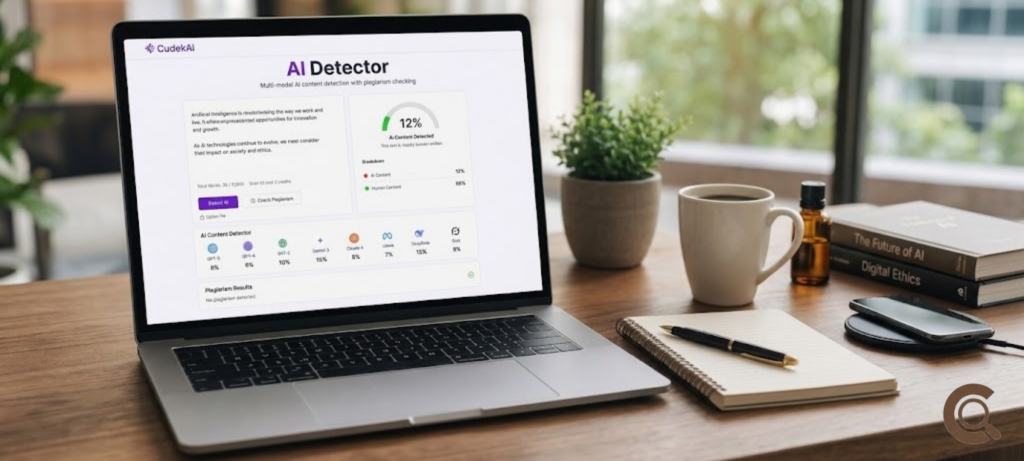
CudekAI AI Detector runs word-level, sentence-level, paragraph-level, and document-level analysis on every scan rather than returning a single unexplained percentage, and names the specific models it checks against: GPT-5, GPT-4, GPT-3, GPT-4.1, Gemini 3, Gemini 2.5 Pro, Gemini 2.5 Flash, Claude Sonnet 4, Llama, DeepSeek, and Grok. That model-by-model breakdown addresses the transparency gap independent testing repeatedly finds in lower-accuracy detectors like Content at Scale and ZeroGPT.
CudekAI AI Detector also combines AI detection with plagiarism scanning in the same scan, so a report distinguishes AI-pattern text from copied text instead of conflating the two categories. The free tier scans up to 15,000 characters per submission across 103 languages, submitted content isn’t stored permanently, and an API supports bulk detection for teams scanning content at scale. CudekAI states its detection model is independently benchmarked to minimize false positives across multiple source models.
Frequently Asked Questions
Can an AI Detector miss AI-generated text entirely?
Yes. Documented testing has shown detectors score unedited AI-generated text as 100% human, and 2026 benchmarks put some detectors’ overall accuracy as low as 46–55%.
Why do two AI Detector tools give different scores for the same text?
Each AI Detector sets its own sensitivity threshold and scores linguistic patterns like predictability and sentence variation differently, so identical text can score anywhere from near-0% to near-100% depending on the tool.
Is an AI Detector the same as a plagiarism checker?
No. A plagiarism checker compares text against a database of existing published content, while an AI Detector estimates the likelihood text was machine-generated without comparing it to any external database.
What AI models can the CudekAI AI Detector identify?
CudekAI AI Detector checks text against GPT-5, GPT-4, GPT-3, GPT-4.1, Gemini 3, Gemini 2.5 Pro, Gemini 2.5 Flash, Claude Sonnet 4, Llama, DeepSeek, and Grok output specifically.
Summary
AI Detector accuracy varies far more than marketing pages suggest: 2026 independent testing puts some widely used free tools at 46–74% overall accuracy with false-positive rates as high as 1 in 5 human texts, while OpenAI discontinued its own classifier after finding it worked barely a quarter of the time. Evaluating an AI Detector means checking its transparency, model coverage, and false-positive data, not just its advertised score. CudekAI AI Detector addresses that gap with model-by-model breakdowns across 11 named AI systems, combined plagiarism scanning, and a 15,000-character free scan across 103 languages.