
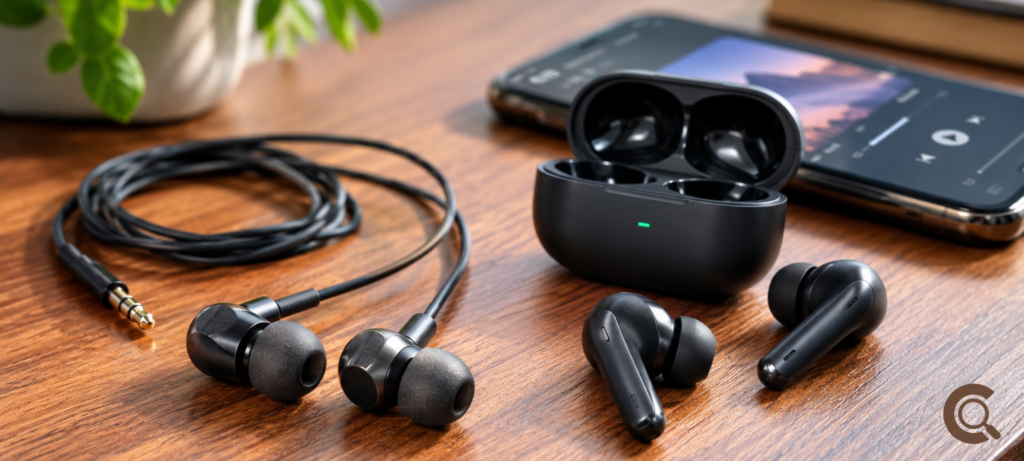
The wired vs wireless earbuds argument usually turns into two camps shouting past each other one insisting Bluetooth “ruins” music, the other insisting nobody can actually hear the difference. Both are partly right, and the actual answer depends on something most people never think to check: which Bluetooth codec their phone and earbuds are actually using, because that single detail changes the answer more than the earbuds themselves do.
Why Wireless Audio Is Compressed in the First Place
Here’s the part that gets left out of most comparisons. Standard, uncompressed CD-quality audio runs at 1,411 kbps. Bluetooth simply doesn’t have that kind of bandwidth to spare reliably — after protocol overhead and error correction, there’s typically well under 1,000 kbps of usable space left for actual audio data. So every Bluetooth codec, without exception, compresses the audio to make it fit. Wired audio doesn’t have this problem at all. A cable carrying a digital signal to a DAC, or a direct analog connection, can transmit audio at whatever resolution the source supports, with zero compression and zero data loss.
That’s the entire root of the debate. It’s not that wireless earbuds are badly made — it’s that Bluetooth audio is inherently a compressed format, and how much it’s compressed depends entirely on which codec is doing the compressing.
The Codec Actually Determines the Sound Quality
This is the detail almost nobody checks before buying wireless earbuds, and it matters more than the brand or the price tag.
| Codec | Max Bitrate | Latency | Notes |
|---|---|---|---|
| SBC | ~328–345 kbps | ~200–220 ms | Mandatory baseline — every Bluetooth device supports it |
| AAC | ~256 kbps | ~200 ms | Apple’s default; excellent on Apple hardware, inconsistent on Android |
| aptX | ~352 kbps | ~70 ms | Android/Qualcomm only, not supported on iPhone |
| aptX HD | ~576 kbps | ~200 ms | 24-bit audio, but latency creeps back up |
| LDAC | Up to 990 kbps | Varies | Sony-developed, widely supported on Android 8.0+, not on iPhone |
| aptX Lossless | Up to ~1.2 Mbps | Low | Truly lossless wireless audio — select Android flagships only |
| Wired (uncompressed) | 1,411 kbps+ | Near zero | No codec negotiation, no compression, no battery required |
The practical takeaway: if your earbuds and phone only manage to connect over SBC — which happens more often than people realize, since it’s the fallback when a better codec isn’t supported on both ends — you’re getting meaningfully compressed audio no matter how good the earbuds themselves are. If you’re on LDAC or aptX Lossless with the full setup working correctly, wireless audio gets remarkably close to wired, and for most listeners in casual conditions, close enough to stop mattering.
Apple Users Are Working With a Real Limitation Here
This is worth calling out specifically because it surprises a lot of people. Every AirPods model, including the higher-end AirPods Max, is capped at AAC — Apple has never added support for LDAC or aptX, regardless of price. That’s not a defect exactly; Apple’s own engineers have stated they don’t consider the codec itself to be the limiting factor on quality. But it does mean iPhone users are locked out of the highest-bitrate wireless codecs entirely, something Android users with the right hardware simply aren’t.
Latency: Where Wireless Still Falls Behind, Regardless of Codec
Sound quality is only half the story. Latency — the delay between audio being sent and actually reaching your ears — is where wired keeps a clear, consistent advantage. SBC and AAC both run somewhere around 200 milliseconds of delay, which is enough to notice audio drifting slightly out of sync with video. aptX cuts that down to roughly 70 milliseconds, which is why it’s marketed heavily for gaming, but even that’s not instant. Wired audio, whether analog or digital, has effectively no meaningful latency at all — the signal just travels down the cable.
For music listening alone, latency rarely matters. For gaming, video editing, or anything requiring tight audio-visual sync, it’s a real and consistent gap that no wireless codec has fully closed.
Does Any of This Actually Matter for Casual Listening?
Here’s the honest, slightly deflating answer: for a lot of everyday listening — commuting, working out, background music while working — the difference between a good wireless codec and wired is genuinely hard to notice, especially through earbuds rather than high-end reference headphones, and especially in a noisy environment where ambient sound already masks fine detail. In controlled, quiet, ABX listening tests, trained listeners can reliably tell LDAC apart from SBC. Untrained listeners in real-world conditions often can’t, or don’t particularly care when they can.
Where the gap becomes genuinely audible for most people is on the low end of the codec range. Going from SBC to literally anything better — AAC, aptX, LDAC — tends to be a noticeable upgrade. Going from AAC or aptX up to LDAC or aptX Lossless is a much smaller, more marginal improvement that mostly matters to people who are already paying close attention with high-quality source material.
Beyond Sound Quality: The Other Trade-offs
Sound quality is only one piece of the wired vs wireless earbuds decision, and for a lot of people, it isn’t even the deciding factor.
Wired earbuds need no charging, have no connection to drop, and work with literally any device with the right port — no codec negotiation, no pairing issues, no battery anxiety. They’re also generally cheaper for comparable sound quality, since you’re not paying for Bluetooth hardware, batteries, or charging cases.
Wireless earbuds trade some of that reliability for genuine convenience — no cable catching on your bag or gym equipment, easier to use while moving around, and increasingly necessary as more phones ship without a headphone jack at all. For most people, that convenience is worth far more day to day than a codec difference they’d need a quiet room and trained ears to actually notice.
If you’re the kind of person who cares about squeezing the most out of your tech setup generally, this kind of head-to-head trade-off shows up in other decisions too — we’ve covered similar ground comparing iOS vs Android, where Bluetooth codec support is actually one of the underrated differences between the two ecosystems, and in our breakdown of Chrome vs Firefox, where the “which one is objectively better” question turns out to depend heavily on what you’re actually optimizing for, the same way it does here.
So Which Should You Actually Buy?
If you’re an audiophile with source material worth the extra fidelity — lossless streaming, FLAC files, a quiet listening environment — wired still wins outright, full stop, with zero compression and zero latency to work around. If you’re an Android user who wants to get as close to wired as wireless currently allows, look specifically for aptX Lossless or LDAC support on both your phone and your earbuds, since the codec matters more than the brand name on the box. If you’re an iPhone user, you’re capped at AAC no matter what you buy, so the meaningful differences between wireless earbuds will come down to drivers, tuning, and noise cancellation rather than codec bragging rights. And if you just want reliable, portable sound without thinking about any of this, modern wireless earbuds on AAC or aptX are genuinely good enough for the overwhelming majority of casual listening.
Frequently Asked Questions
Do wireless earbuds actually sound worse than wired ones?
It depends entirely on the codec. On the baseline SBC codec, yes, noticeably. On LDAC or aptX Lossless with proper hardware support on both ends, the gap narrows to the point where most listeners can’t reliably tell the difference in everyday conditions.
What’s the best-sounding Bluetooth codec currently available?
aptX Lossless offers true lossless wireless audio, with LDAC close behind at up to 990 kbps. Both require specific Android hardware support and aren’t available on iPhones.
Why don’t AirPods support LDAC or aptX?
Apple has stated it doesn’t consider the codec itself to be the limiting factor on AirPods’ sound quality, and has stuck with AAC and SBC across every AirPods model regardless of price.
Does Bluetooth audio have noticeable latency compared to wired?
Yes, generally. SBC and AAC run around 200 milliseconds of delay; aptX cuts that to roughly 70ms. Wired audio has effectively no perceptible latency by comparison.
Is it worth buying wired earbuds just for better sound quality?
For critical, focused listening with high-quality source material, yes, wired remains the more reliable choice. For casual daily use, a good wireless codec is close enough that the convenience trade-off is usually worth it for most people.
Final Thoughts
The real answer in the wired vs wireless earbuds debate isn’t a flat “wired always wins” or “nobody can tell the difference” it’s that the gap is almost entirely determined by which Bluetooth codec is actually in use, not by wireless technology in general. On a weak codec, the difference is real and often audible. On a strong one, wireless gets close enough that convenience becomes the more sensible deciding factor for most people. Check what your phone and earbuds actually support before assuming either side of this argument is automatically right for your setup.