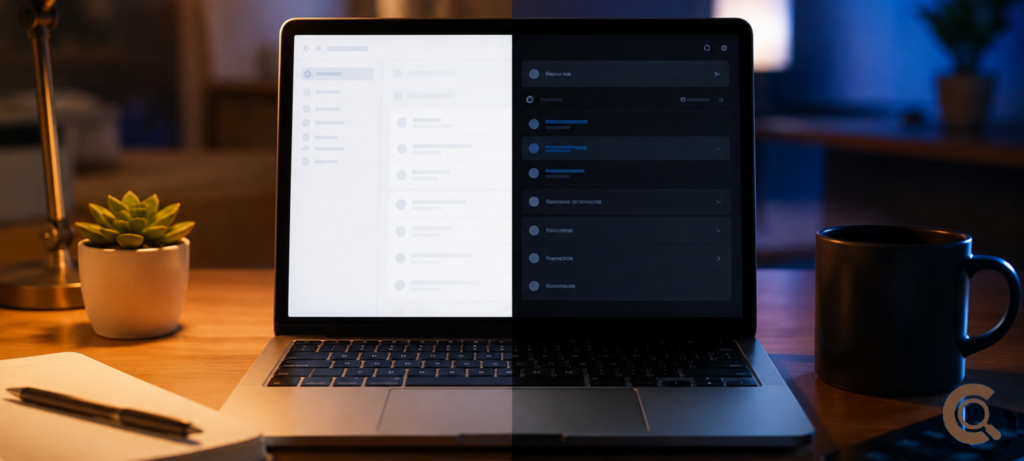
Somewhere along the way, dark mode turned into a personality trait. People argue about it the way they argue about pineapple on pizza — with way more confidence than the actual evidence supports. So let’s actually look at the dark mode vs light mode question properly: what the eye research says, what’s just internet folklore repeated so often it sounds true, and which setup genuinely makes sense depending on when and how you’re using your screen.
The Blue Light Myth Everyone Still Believes
Before getting into dark mode specifically, it’s worth clearing up the thing most of this debate is actually built on: blue light. A huge amount of dark-mode marketing leans on the idea that blue light from your screen is damaging your eyes, and that switching to a darker interface protects you from it.
That’s not really supported by the evidence. The American Academy of Ophthalmology has stated plainly that there’s no scientific proof that blue light from phone or computer screens causes eye damage, and the organization doesn’t recommend blue-light-blocking glasses for that reason. What people actually experience after long screen sessions — the tired, dry, gritty feeling — is called digital eye strain, or computer vision syndrome, and it comes mostly from something much less exotic than blue light: you blink less when staring at a screen. A normal blink rate is somewhere around 15 times a minute. Staring at a screen, that can drop to five or seven. Less blinking means a drier eye surface, and that’s where most of the discomfort actually comes from, regardless of whether your screen is set to dark or light.
None of that means dark mode doesn’t matter at all, though. It just means the “protecting your eyes from harmful light” framing is mostly marketing. The real effects are more specific, and more interesting, than that.
Where Dark Mode Actually Causes a Problem: Halation
Here’s the part of the dark mode vs light mode debate that’s genuinely backed by real optics, not just internet opinion. When you switch to dark mode, your pupils dilate to let in more light, since the overall screen is dimmer. A wider pupil lets in light through a larger area of your eye, and for a lot of people, that has essentially no downside.
But for people with astigmatism — a very common condition where the cornea isn’t perfectly round — a dilated pupil makes things measurably worse for reading small text. Light entering through the edges of an irregularly shaped cornea refracts differently than light through the center, and the result is a visual effect called halation: bright text on a dark background appears to glow, bleed, or blur slightly at the edges. If you’ve ever switched your phone to dark mode and noticed the text looking slightly fuzzy or “smeared,” that’s very likely what’s happening, especially with smaller font sizes.
This is why several ergonomics studies on reading comprehension have found that dark text on a light background — what’s sometimes called positive polarity — tends to produce faster reading speeds and fewer errors than light text on a dark background, particularly for longer reading sessions. It’s not a huge effect for everyone, but if you already have astigmatism, even mild and corrected with glasses or contacts, it’s often the actual explanation behind why dense reading feels more tiring in dark mode.
Dark Mode vs Light Mode for Reading: Does It Make a Difference?
For short glances — checking a notification, skimming a message — the difference between light mode vs dark mode reading is negligible for almost everyone. Where it becomes noticeable is during long, focused reading sessions: articles, documents, code, anything requiring sustained attention to small text for more than a few minutes at a time.
If you have astigmatism and do a lot of reading on-screen, light mode is generally the more comfortable choice for that specific task, even if dark mode still feels more visually appealing to you for browsing or casual use. There’s no rule that says you have to pick one mode for everything — plenty of people use light mode for documents and reading apps, and dark mode for everything else.
Where Dark Mode Actually Wins
Dark mode isn’t just an aesthetic preference with no real upside — it has a few genuine advantages, just not the ones most marketing claims.
Low-light comfort. In a dark room, a bright white screen creates a real contrast problem — your pupils are adjusted to the dark environment, and the sudden brightness forces them to constrict rapidly, which is genuinely uncomfortable and can contribute to eye fatigue during nighttime scrolling. Dark mode reduces that contrast shock significantly.
Battery life on OLED screens. This has nothing to do with your eyes directly, but it’s a real, measurable benefit. On an OLED or AMOLED display, black pixels are essentially switched off rather than lit and dimmed. A dark-mode interface with mostly black backgrounds can noticeably extend battery life compared to a bright white interface, especially with the screen at higher brightness.
Reduced blue light emission at night. Because dark mode uses fewer bright white pixels overall, it does modestly reduce the total amount of blue light your screen emits in the evening — not because blue light itself is dangerous to your eyes, as covered earlier, but because of its separate, well-documented effect on sleep.
The Part That Actually Matters at Night: Melatonin, Not Eye Damage
This is where the science is genuinely solid, and it’s a different issue entirely from eye strain. Blue light doesn’t damage your eyes, but it does interfere with sleep. Harvard researchers found that blue light exposure suppressed melatonin — the hormone that regulates your sleep-wake cycle — for roughly twice as long as equally bright green light, and shifted circadian rhythm timing by a similar margin. Exposure to bright light of any kind late at night pushes your body’s internal clock later, but blue wavelengths specifically have an outsized effect on that shift.
So if you’re using dark mode late at night to “protect your eyes,” the honest framing is slightly different: it’s not your eyes it’s helping, it’s your ability to fall asleep at a reasonable hour. Reducing screen brightness generally and avoiding bright screens in the hour or two before bed matters more here than which color scheme you’re using specifically.
So Which Should You Actually Use?
Based on what the research actually supports, rather than what dark-mode culture insists:
- For long reading sessions, documents, or anything with small dense text — light mode is generally the more comfortable, faster-to-read option, especially if you have any degree of astigmatism.
- For nighttime use, low-light rooms, or general browsing where text density is lower — dark mode reduces contrast shock and is genuinely easier on your eyes in a dim environment.
- If eye strain is your main concern regardless of mode — the fix that actually matters most is the 20-20-20 rule recommended by the American Academy of Ophthalmology: every 20 minutes, look at something roughly 20 feet away for 20 seconds. This addresses the real cause of digital eye strain (reduced blinking) far more directly than switching color schemes ever will.
- If sleep is the concern — reduce screen brightness and avoid screens generally in the hour or two before bed. Dark mode helps marginally, but it’s not a substitute for actually dimming the light source itself.
Most modern operating systems let you schedule dark mode to switch on automatically at sunset, which is a reasonable middle ground if you don’t want to think about it daily. If you’re weighing this alongside other display and settings choices across your devices, it’s worth checking how the two major browsers actually differ, too — our Chrome vs Firefox comparison covers how each handles display settings, extensions, and privacy, which often factors into the same “which setup should I actually use” decision. The same logic applies at the operating system level — our iOS vs Android comparison covers how each platform handles dark mode, display customization, and battery behavior differently.
Frequently Asked Questions
Does dark mode actually help your eyes?
Not in the way most people assume. It doesn’t protect you from blue light damage, since there’s no strong evidence blue light damages eyes in the first place. It does reduce contrast shock in low light and can modestly reduce nighttime blue light exposure, which matters more for sleep than for eye health directly.
Is dark mode worse for people with astigmatism?
For dense text and long reading sessions, yes, generally. The dilated pupil in dark mode can cause a halation effect that makes text look fuzzy for people with astigmatism, though corrective lenses reduce this significantly.
Does dark mode save battery?
On OLED and AMOLED screens, yes, meaningfully, since black pixels use little to no power. On older LCD screens, the battery difference is minimal.
What actually causes digital eye strain if it’s not blue light or screen mode?
Mostly reduced blinking during screen use, which dries out the eye surface. The American Academy of Ophthalmology recommends the 20-20-20 rule as the most effective fix.
Should I use dark mode at night to sleep better?
It can help slightly by reducing overall screen brightness, but reducing brightness and avoiding screens in the hour or two before bed matters more than which color mode you’re using.
Which is better, dark mode vs light mode?
Neither is universally better. Light mode is generally more comfortable for long reading and dense text, while dark mode can feel easier in low-light environments and may reduce glare. The better choice depends on your surroundings, the type of content you’re viewing, and what feels most comfortable for your eyes.
Final Thoughts
The real answer to dark mode vs light mode isn’t that one is universally healthier — it’s that each one solves a different, specific problem. Light mode tends to be easier to read for long stretches, especially if you have astigmatism. Dark mode is more comfortable in low light, saves battery on OLED screens, and modestly reduces blue light exposure at night. Neither one is protecting your eyes from damage that current research doesn’t actually show exists, and if eye strain is your real concern, a proper break schedule will do more for you than any color scheme switch ever will.