
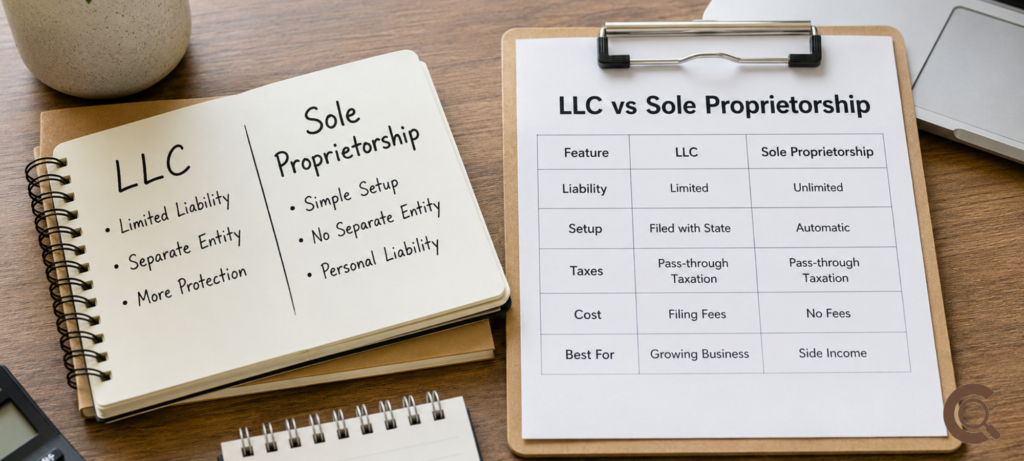
If you’re making money on the side freelancing, selling something online, doing consulting on evenings and weekends, you’ve probably run into the LLC vs sole proprietorship question at some point. It sounds like a big legal decision, but for most small side businesses, it actually comes down to a handful of practical trade-offs: how much personal risk you’re comfortable with, how much paperwork you want to deal with, and whether the tax difference is even worth it yet.
What a Sole Proprietorship Actually Is
A sole proprietorship isn’t something you apply for. If you start earning money from a side business and haven’t registered anything else, you’re already a sole proprietor by default. There’s no separate legal entity — you and the business are the same thing in the eyes of the law.
That simplicity is the appeal. No formation paperwork, no state filing fees, and taxes flow straight onto your personal return using Schedule C. But that same lack of separation is the catch: if the business gets sued or racks up debt it can’t pay, your personal assets — your savings, your car, potentially your house — are on the line. There’s no shield between “you” and “the business” because legally, there isn’t one.
What an LLC Changes
An LLC, or limited liability company, creates a separate legal entity between you and your business. That’s the entire point of the structure, and it’s where the name comes from. If the business is sued or can’t pay a debt, creditors generally can’t come after your personal assets — only what’s inside the business itself.
Setting one up means filing Articles of Organization with your state’s Secretary of State, paying a filing fee (this varies significantly by state, often somewhere between $50 and $500), and in some states, maintaining a registered agent. A single-member LLC — meaning just you as the owner — is still taxed as a sole proprietorship by default unless you actively elect otherwise, so the tax filing itself doesn’t automatically get more complicated just because you formed an LLC.
LLC vs Sole Proprietorship for Small Business: Where the Real Difference Shows Up
For a small side business, the LLC vs sole proprietorship for small business decision usually comes down to three things.
Liability. This is the big one. If your side business involves any real risk — client work where something could go wrong, physical products, advice you’re giving people, anything where a lawsuit is even remotely plausible — the personal liability protection an LLC offers is worth taking seriously. If you’re selling handmade crafts on weekends with essentially zero realistic liability exposure, the risk calculation looks very different.
Taxes. Sole proprietorship vs LLC taxes is a common source of confusion, mostly because a default single-member LLC is taxed exactly the same way as a sole proprietorship — both report business income on Schedule C, and both pay self-employment tax on net earnings. The tax benefits people associate with LLCs usually come from electing S corp taxation status, which is a separate decision on top of forming the LLC, not something that happens automatically. That election only tends to make financial sense once your side business is generating consistent profit, not from day one.
Credibility and separation. Some clients, especially larger ones, feel more comfortable working with an LLC than an individual. It’s a minor factor, but for freelancers and consultants building a client base, it can occasionally tip the scales.
Should I Form an LLC for a Side Business?
The honest answer: it depends on how real the risk is and how serious the side business is becoming.
If you’re just testing an idea — a few hundred dollars a month, low risk, no employees, no physical product that could injure someone — staying a sole proprietor while you figure out if the business has legs is a completely reasonable choice. You can always form an LLC later once there’s actual revenue and actual risk to protect.
If you’re already invoicing real clients regularly, working with contracts, or handling anything where a mistake could realistically lead to a claim against you, that’s usually the point where forming an LLC starts making practical sense rather than feeling like overkill.
Comparison at a Glance
| Factor | Sole Proprietorship | LLC |
|---|---|---|
| Setup | None — automatic by default | File Articles of Organization with your state |
| Cost | $0 | State filing fee (typically $50–$500) |
| Personal liability | Unlimited — no separation | Limited to business assets in most cases |
| Default taxation | Personal return, Schedule C | Same as sole proprietorship, unless you elect S corp status |
| Ongoing paperwork | Minimal | Annual reports/fees required in many states |
| Best for | Low-risk, early-stage side income | Anything with real liability exposure or growing revenue |
How to Start an LLC If You Decide to Go That Route
The process is fairly consistent across states, even though the details and fees vary. You’ll choose a business name that meets your state’s requirements, file Articles of Organization with the Secretary of State, get an EIN from the IRS (free, and needed to open a business bank account), and in many states, file an operating agreement — not always legally required, but genuinely useful for outlining how the business is run, especially if you ever bring on a partner.
Opening a dedicated business bank account is worth doing regardless of which structure you choose, but it becomes more important with an LLC. Mixing personal and business funds — commonly called “commingling” — can undermine the liability protection an LLC is supposed to provide in the first place.
Where to Get Accurate, Unbiased Information
Since this decision has real legal and tax consequences, it’s worth checking official sources rather than relying only on blog posts (including this one). The U.S. Small Business Administration has a clear, current breakdown of each business structure, and the IRS explains exactly how each one is taxed. For a side business generating meaningful income, a short consultation with an accountant or business attorney is often worth the cost before you file anything.
If you’re already freelancing and trying to get the financial side of your side business organized, it’s worth reading through how to create an invoice as a freelancer as well — invoicing properly matters regardless of which business structure you end up choosing.
Frequently Asked Questions
What’s the main difference between an LLC and a sole proprietorship?
Personal liability. A sole proprietorship offers no legal separation between you and the business, while an LLC generally protects your personal assets from business debts and lawsuits.
Do I pay less in taxes with an LLC vs sole proprietorship?
Not automatically. A default single-member LLC is taxed the same as a sole proprietorship. Tax savings usually require electing S corp status separately, which typically only makes sense once the business is consistently profitable.
Should I form an LLC for a small side business?
It depends on your actual liability exposure. Low-risk, early-stage side income often doesn’t need one yet. Real client contracts, physical products, or growing revenue are common signs it’s time to consider it.
How much does it cost to start an LLC?
It varies by state, generally somewhere between $50 and $500 for the initial filing, plus potential annual report fees depending on where you’re registered.
Can I switch from a sole proprietorship to an LLC later?
Yes. Plenty of people start as a sole proprietor and form an LLC once the business grows or the liability risk becomes real. There’s no requirement to decide everything on day one.
Final Thoughts
There’s no universally correct answer in the LLC vs sole proprietorship decision — it depends on how much risk your specific side business carries and how serious it’s becoming. If you’re just starting out with low stakes, staying a sole proprietor while you figure things out is genuinely fine. Once real liability enters the picture, forming an LLC is usually the more sensible move, even with the added paperwork and cost. When in doubt, the official SBA and IRS guides are worth reading before you file anything, and a quick conversation with a professional can save you from a costly mistake either way.